Design Systems
That Scale.
Engineers That Lead.
|
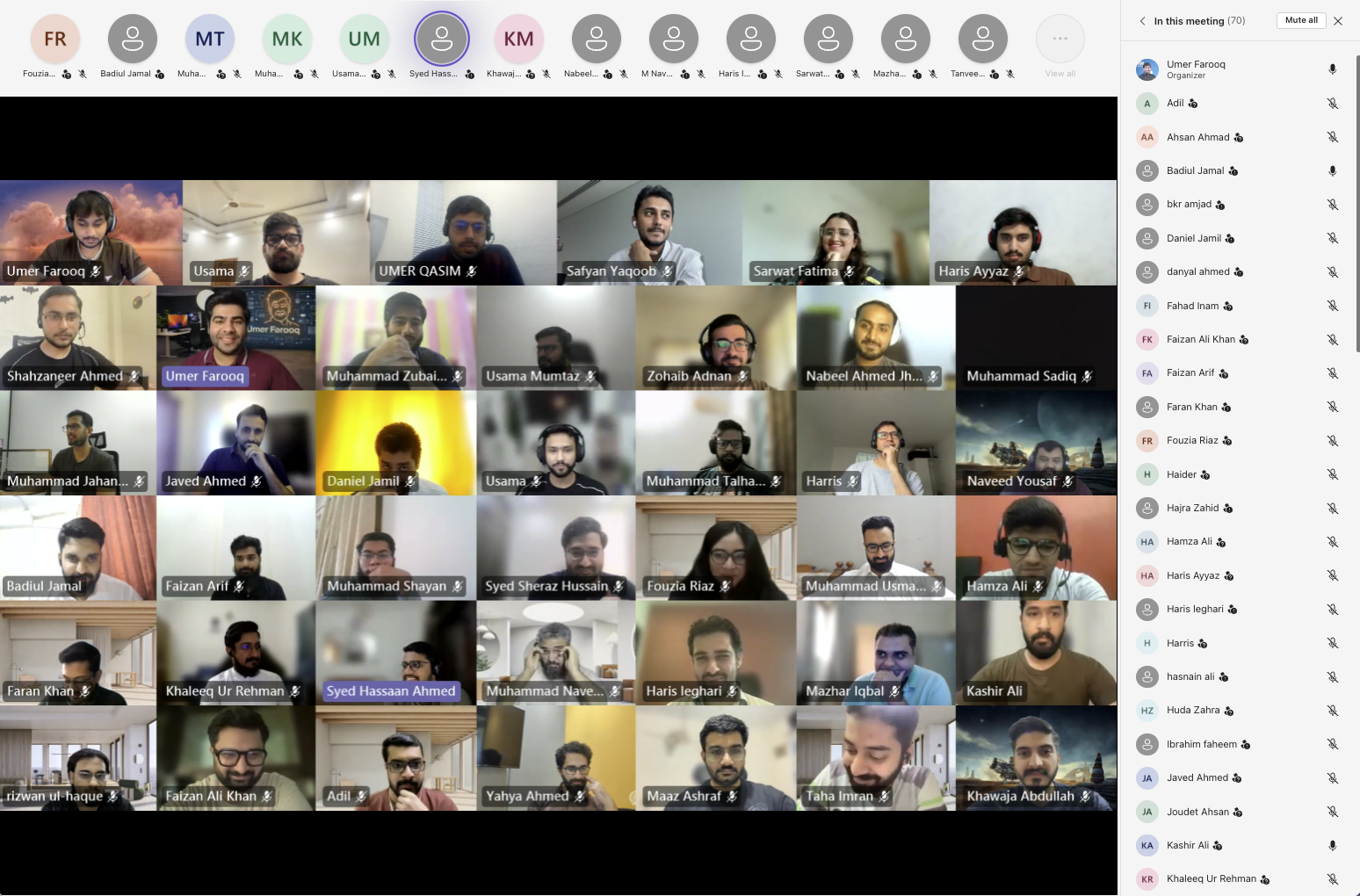
8 live sessions on Microsoft Teams. No slides — only first-principles thinking, real architectures, and the decisions that separate senior engineers from everyone else.
Why This Matters
System Design is the skill gap nobody talks about
Every engineer hits this wall. Most never figure out why. The ones who do go on to lead, to architect, and to build the systems that matter.
The hard truth: Nobody is going to teach you this at work. Your manager assumes you know it. Your university did not cover it. Most online courses give you diagrams to memorise — not the mental models to reason from scratch.
The Interview Wall
System design rounds are the filter that separates junior from senior at every serious company. Most engineers never prepare for it — because nobody told them it was the deciding round. It is not about intelligence. It is about a way of thinking that was never taught.
hover to read more
of senior-level interviews include a system design round
Universities Teach the Wrong Things
Four years of algorithms and theory — and zero hours on how to design a system that actually scales. Nobody taught you replication, sharding, or how to make a trade-off decision under real constraints. The industry expects you to already know this. You were never shown.
hover to read more
hours on system design in most CS/SE university programmes
AI Has Commoditized Coding
AI writes boilerplate, generates functions, and debugs code. Coding alone is no longer a differentiator. The engineers who will lead in the AI era design the systems — deciding what gets built, how it scales, and why each trade-off was made. That is not a skill AI can replace.
hover to read more
rising demand for architects and system thinkers — not just coders
The Invisible Career Ceiling
Most engineers hit a ceiling at 3–5 years and never break through. The ones who do are not smarter coders — they think in systems, see trade-offs, and design before they build. System design is how you earn a seat at the table where the real decisions get made.
hover to read more
faster career growth for engineers who can design at scale
You Can Code. You Cannot Design.
You have been writing code for years — but freeze the moment someone asks you to design a system.
You know the tools — databases, caches, queues — but not when to use what, and why.
of developers can confidently design a scalable system end-to-end without freezing
Working Hard. Being Overlooked.
A colleague who joined after you got promoted. You know you are more capable. But they could talk architecture.
You ship features every sprint — but nobody asks your opinion on how the system should actually be built.
more likely to be passed over for promotion if you cannot speak architecture in the room
This course exists because that gap is real, fixable, and costing you — in interviews, in your career, and in the quality of systems you build every day.
See what we coverThe Curriculum
8 sessions. 4 weeks. Everything that matters.
No slides. No memorisation. Every session is a live, adaptive deep-dive — shaped by your questions, covering real architectures used at scale.
4
Weeks
8
Sessions
60+
Topics
Live
MS Teams
- Why System Design matters — in interviews and in real-world engineering
- The core building blocks of every scalable system
- Mathematical calculations for scale — how to estimate capacity
- Different architectural approaches and their trade-offs
- Performance, Redundancy, Availability, and Robustness
- SLAs — how to design systems that meet them
- Load Balancers, Auto Scaling, Caches, Heartbeats, CDN
- Why System Design matters — in interviews and in real-world engineering
- The core building blocks of every scalable system
- Mathematical calculations for scale — how to estimate capacity
- Different architectural approaches and their trade-offs
- Performance, Redundancy, Availability, and Robustness
- SLAs — how to design systems that meet them
- Load Balancers, Auto Scaling, Caches, Heartbeats, CDN
What You'll Master
Foundations of Scalable Systems
Click any topic node to explore what's covered in depth.
Click any topic to explore what you’ll learn
Hover a topic above to see what's covered
Note: Topics evolve based on student questions — no rigid slides. This is a live, interactive experience where the best questions drive the deepest learning.
Your Instructor
Built by someone who did the work.
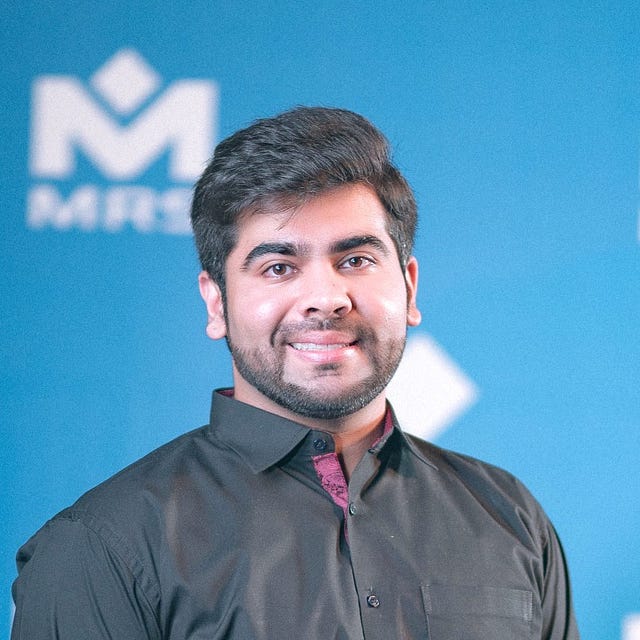
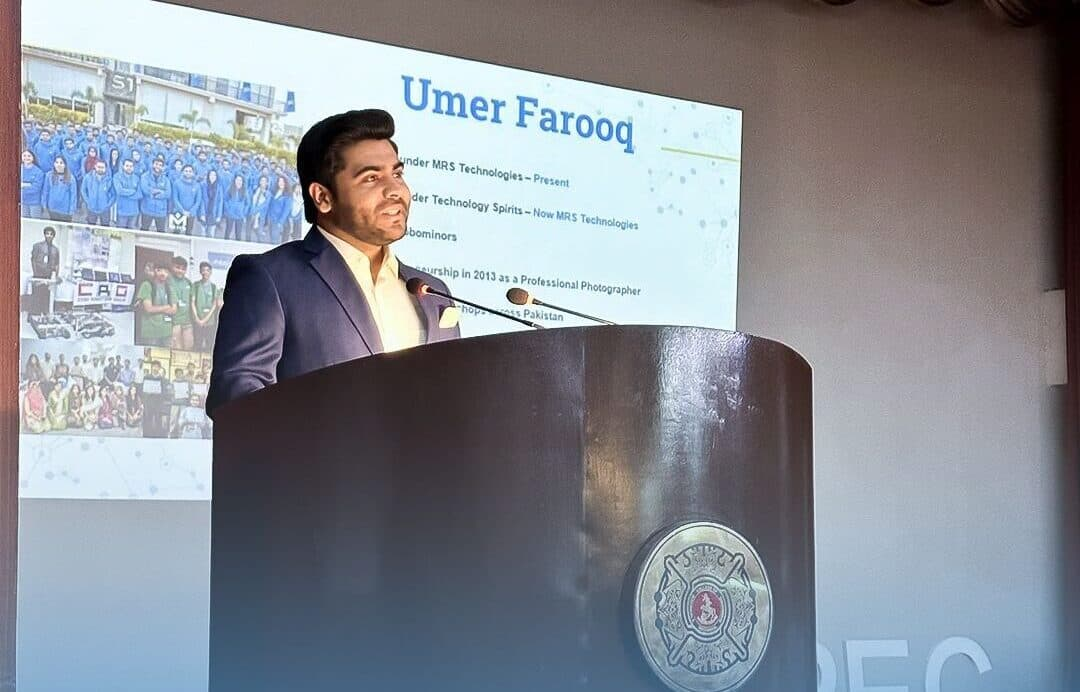
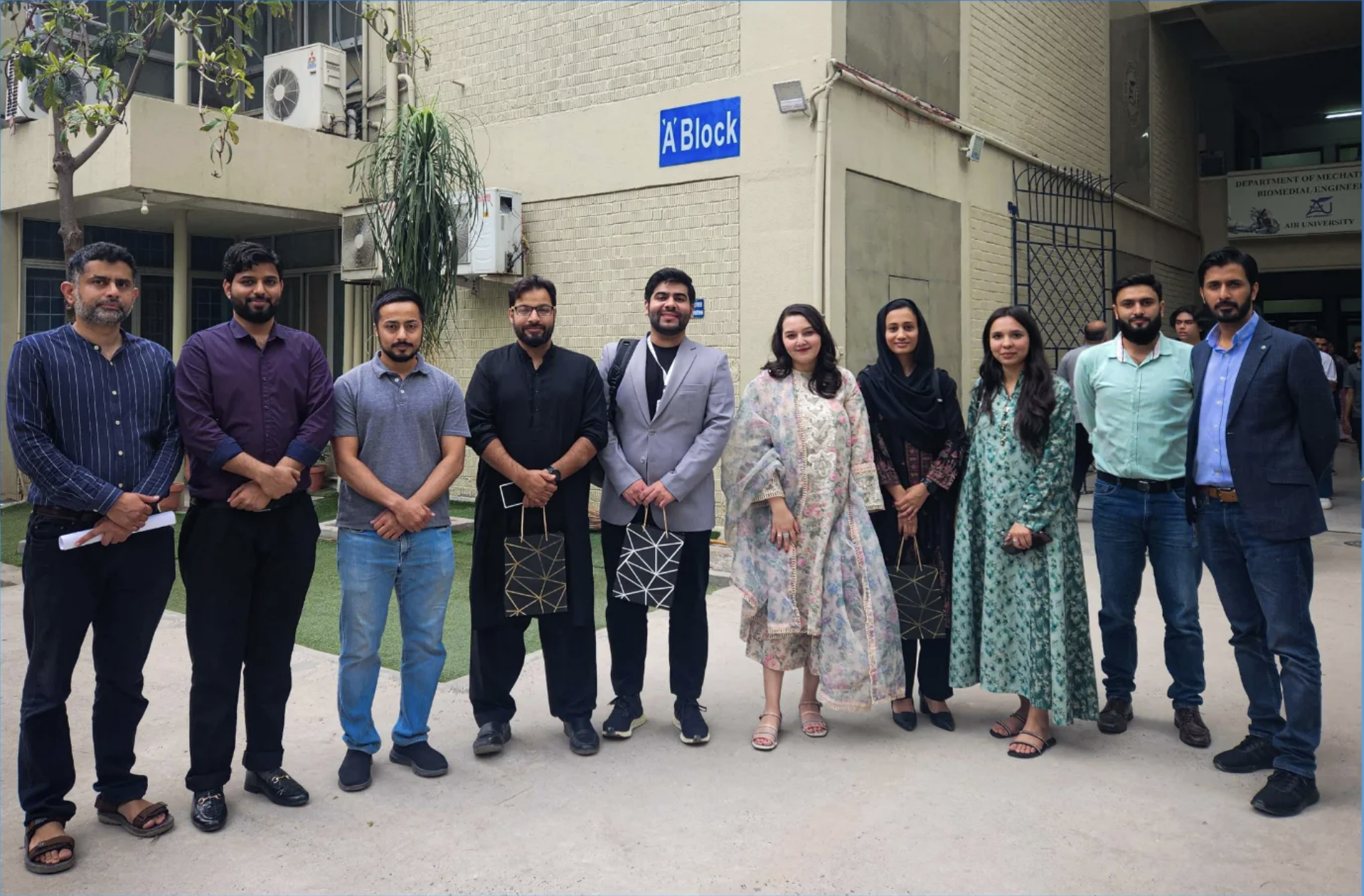
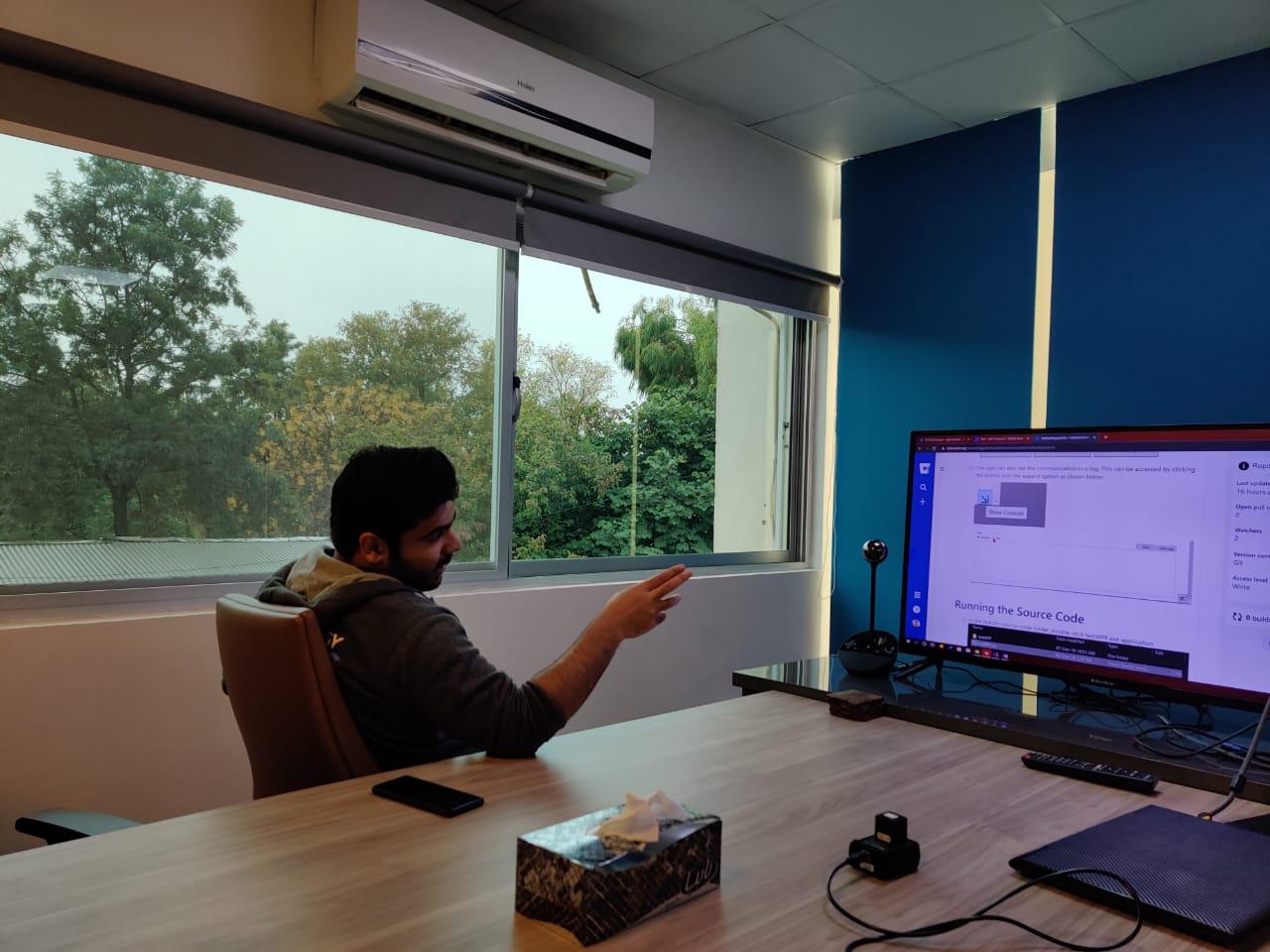
Umer Farooq
Entrepreneur · Chief Technology Officer · Double Gold Medalist
14+ Years Building Real Systems
14+
Years of Experience
2×
Gold Medalist
System Design Masterclass
6
Cohorts Delivered
490+
Alumni Trained
Teaching & Coaching
100+
Technical Workshops Across Pakistan
100+
1:1 Career Therapy Sessions
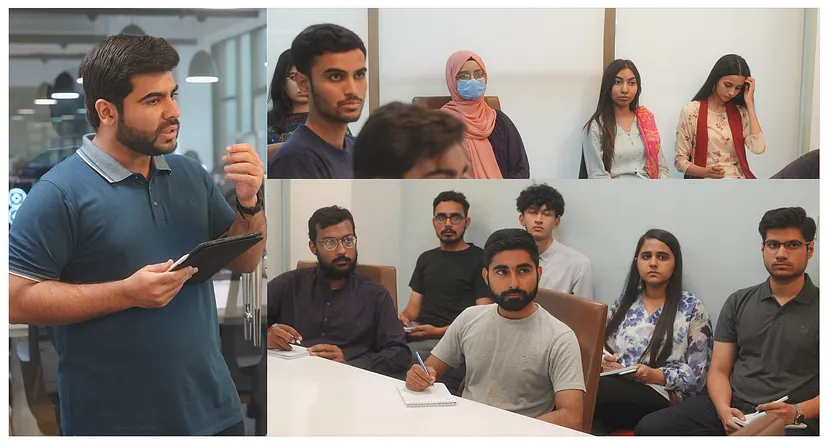
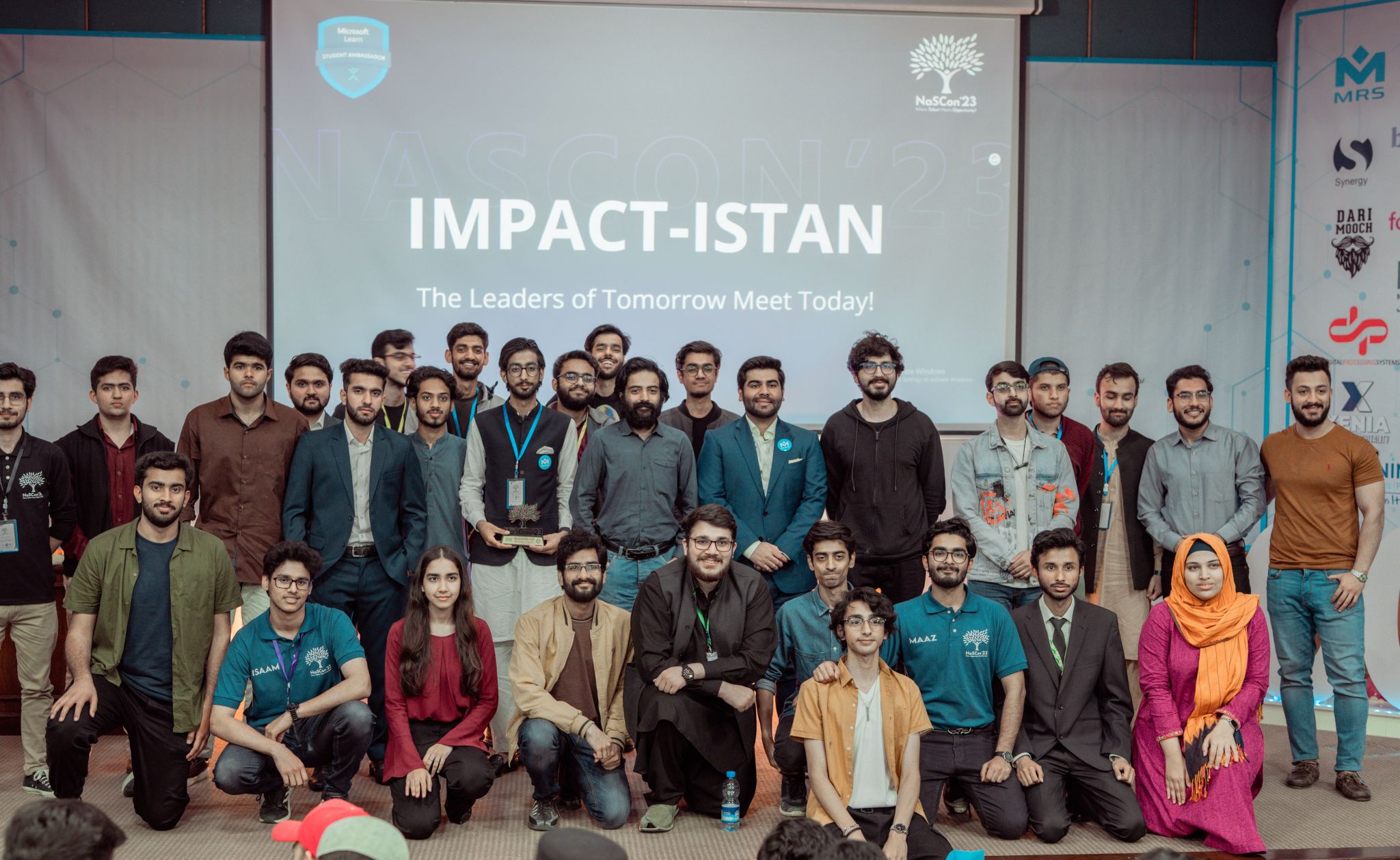
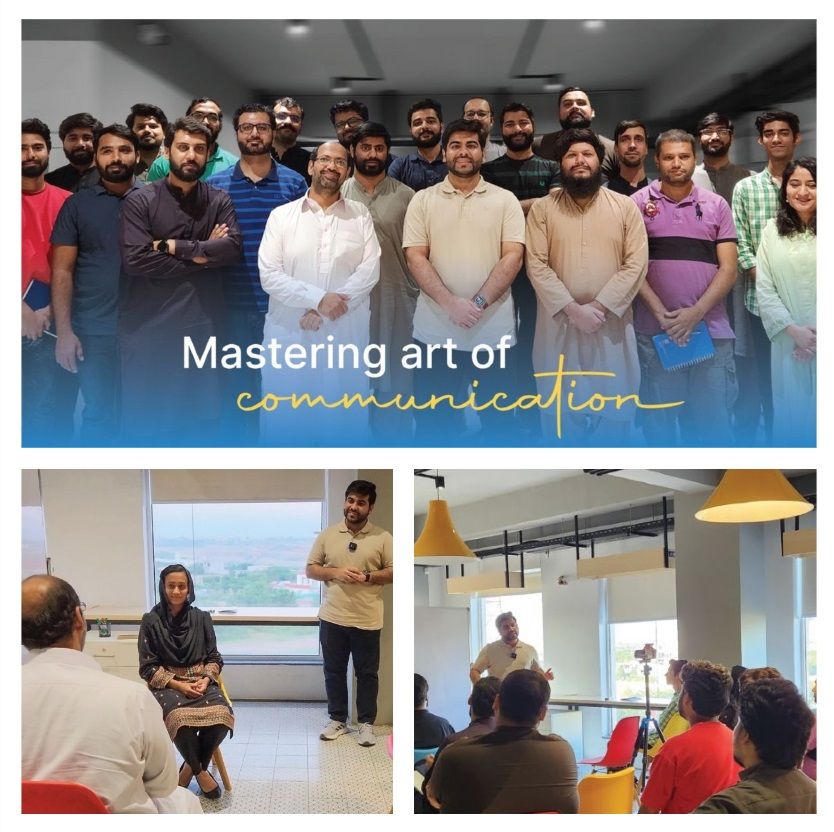
Umer Farooq's obsession with computers began before second grade — modifying operating system files, working through programming books, and dreaming of founding his own company. That curiosity led him to land his first professional internship in 9th grade, making him the youngest hire at a software house where he built 3D games and delivered full web development projects.
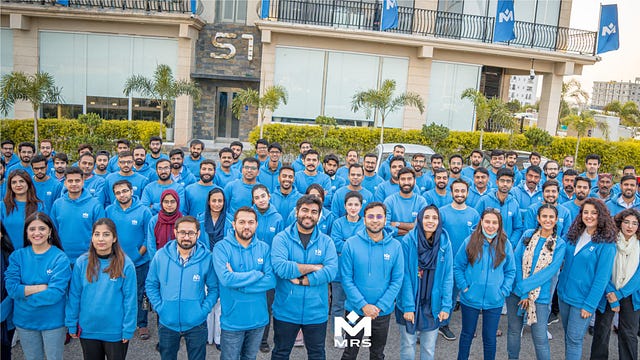
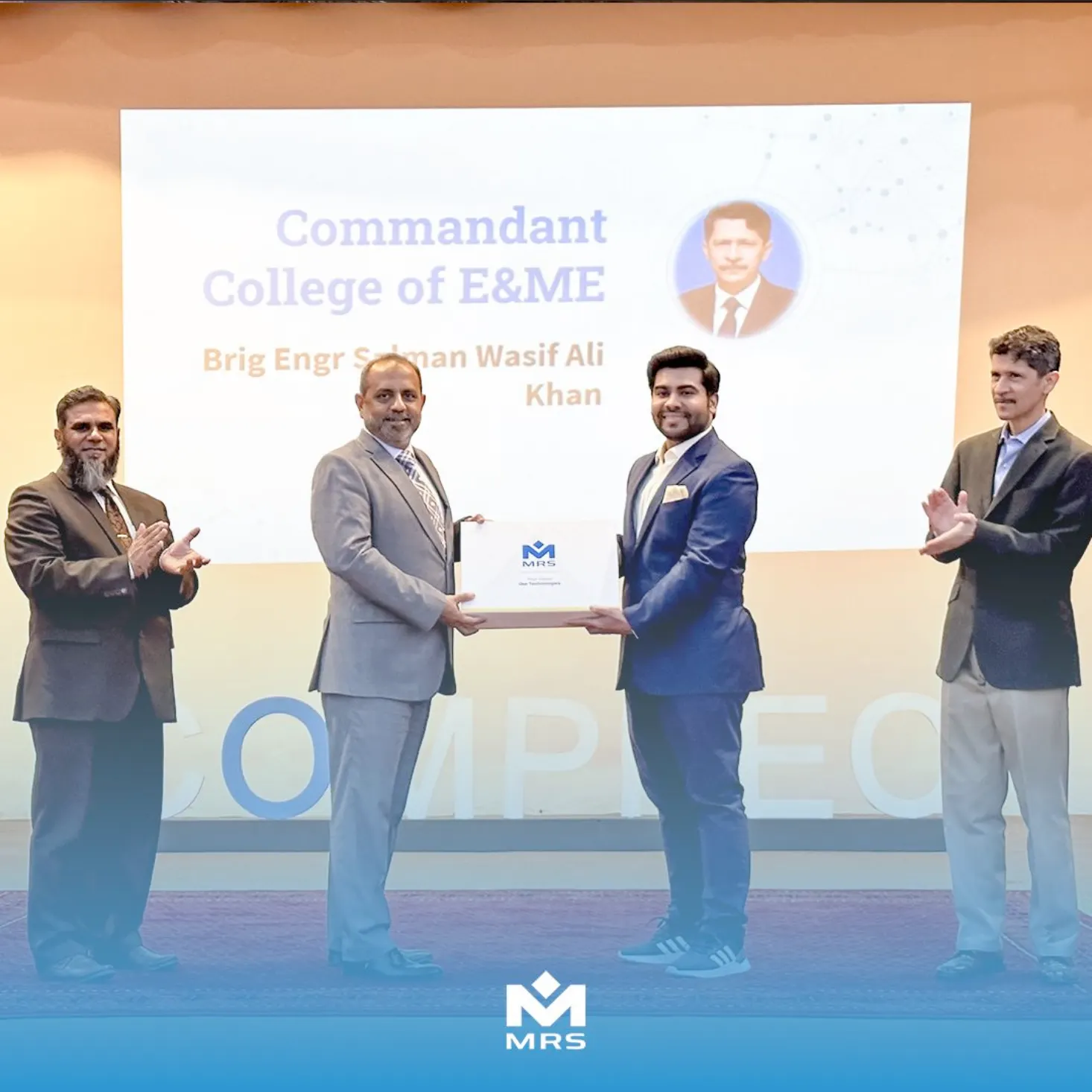
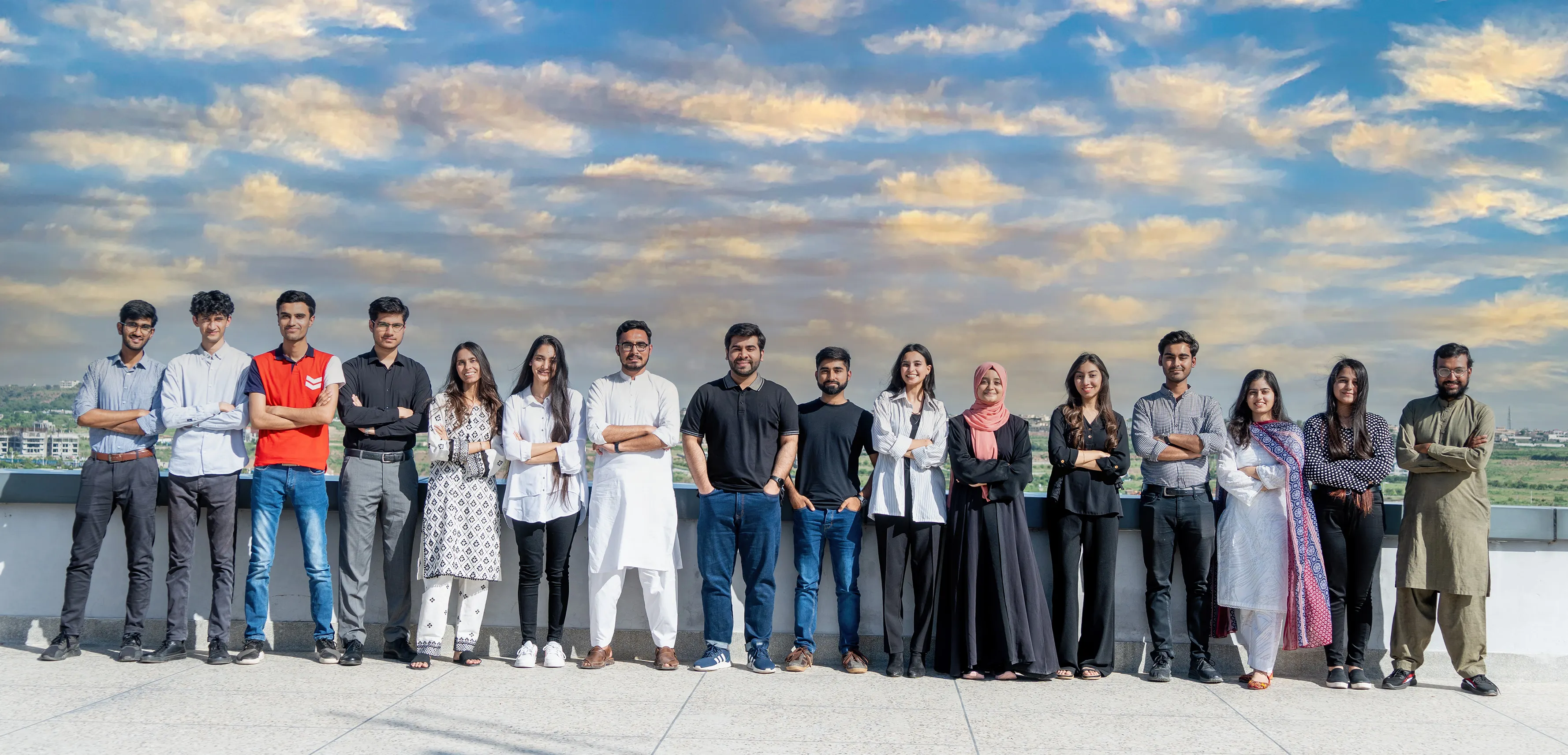
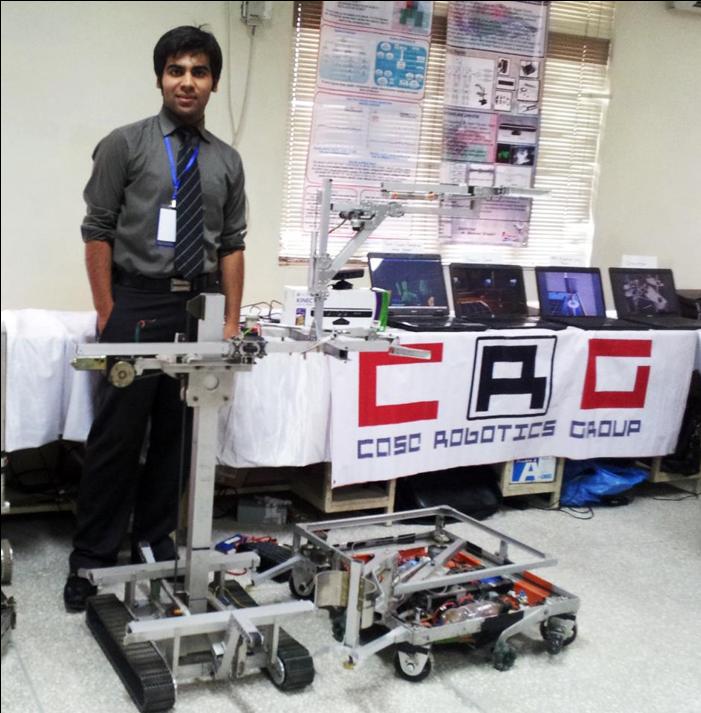
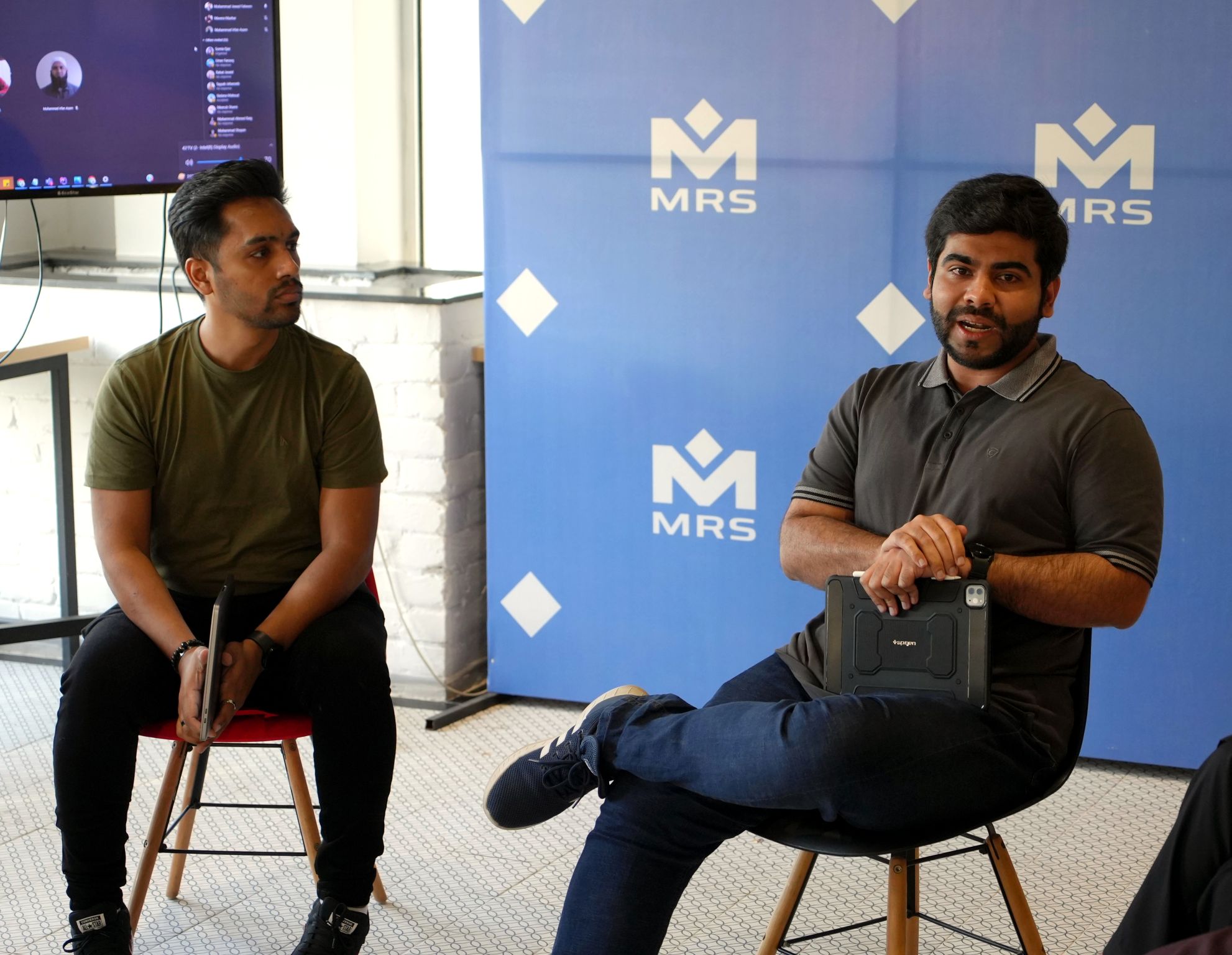
During his undergraduate years he represented Pakistan three times at ABU Robocon — the Asia-Pacific Robotics Championship — a national record that still stands. He went on to serve as Chief Technology Officer at MRS Technologies, leading enterprise solutions in embedded systems, smart security, and energy management for clients across Pakistan and beyond — growing the company from 24 to 150+ people under his leadership.
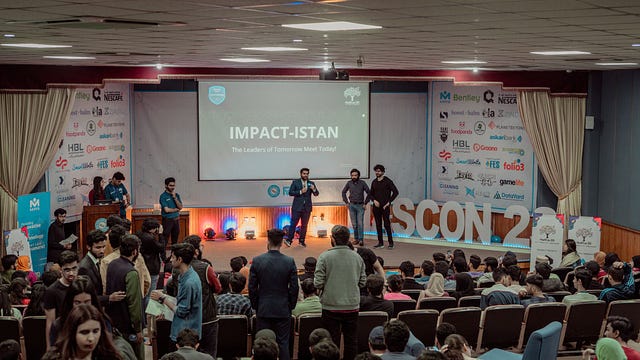
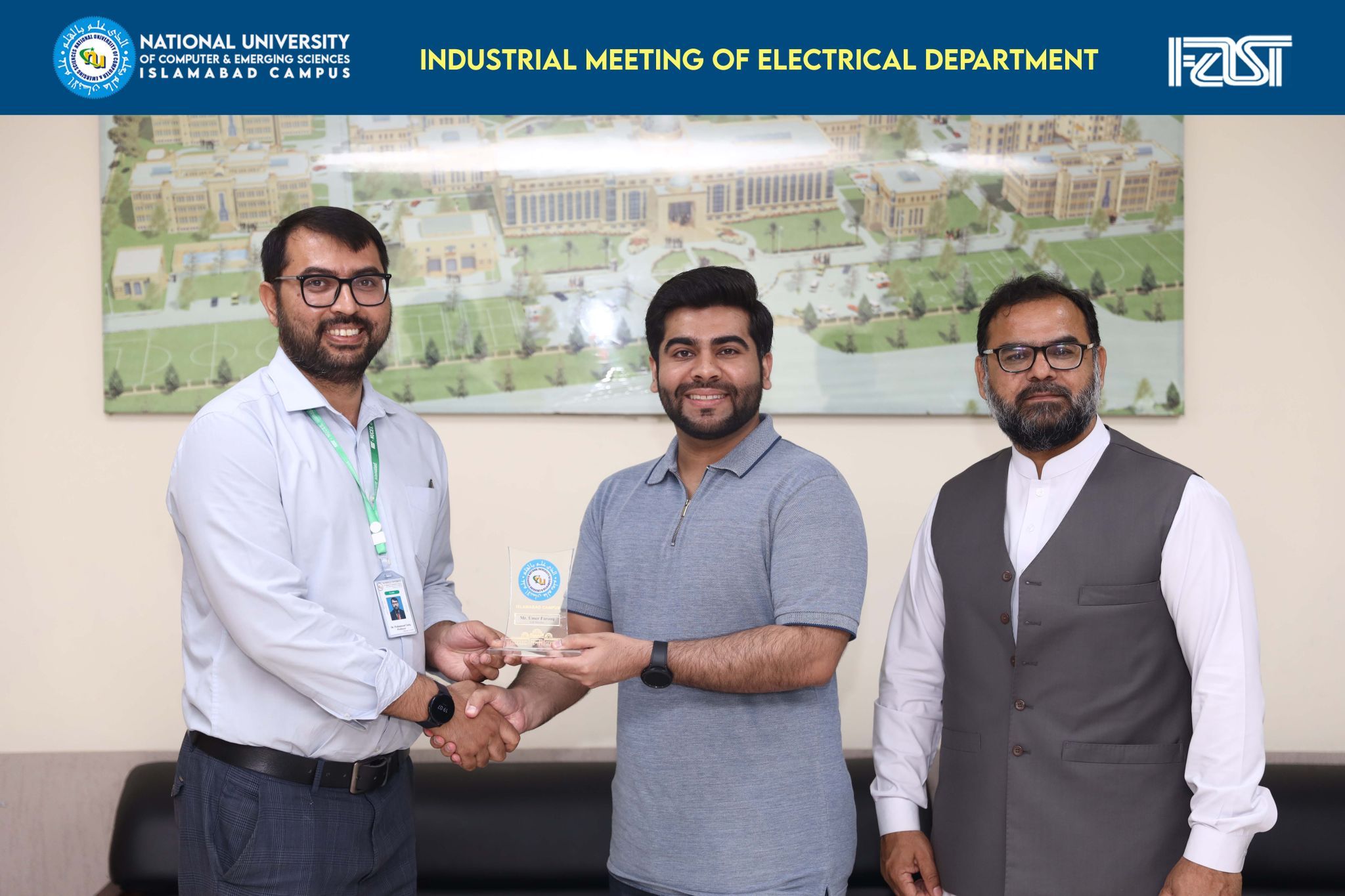
He holds a President's Gold Medal from NUST (MS Robotics, 4.00 CGPA) and a Gold Medal from CASE in Electrical Engineering. He has delivered 100+ workshops across Pakistan on robotics and technology, and currently runs Pakistan's largest live System Design Masterclass with 490+ engineers trained across 6 cohorts.
“I started with curiosity — no blueprint, no shortcut, no guarantee. Everything I've built came from refusing to stop when things got hard. That's the only edge worth having.”
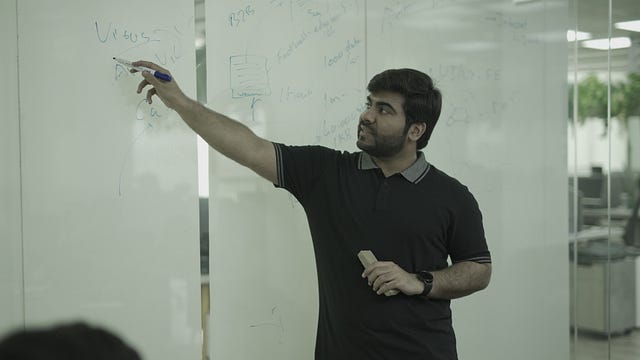


The Journey
From curious kid to CTO.
9th Grade
First Professional Internship
Landed his first professional internship while still in 9th grade — the youngest hire at a software house — where he built a 3D game using OpenGL, designed interactive applications in Macromedia Flash, and delivered full web development projects.
2010 — 2012
ABU Robocon · Representing Pakistan & Gold Medal, CASE
Represented Pakistan three consecutive years (2010, 2011, 2012) at ABU Robocon — Asia's largest robotics competition spanning the Asia-Pacific region — a record for any undergraduate student in Pakistan that still stands. Graduated with a Gold Medal in Electrical Engineering from Sir Syed CASE Institute of Technology.
2016
Co-Founder · Robominors
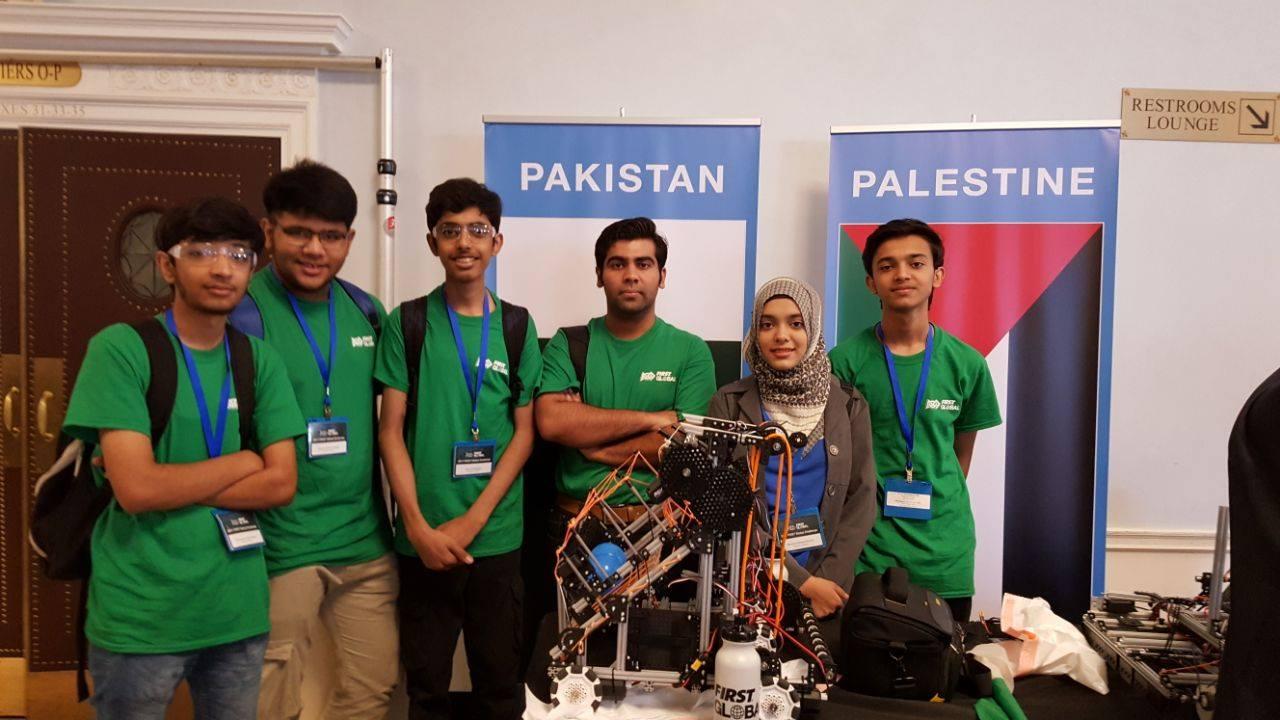
Co-founded Robominors, a robotics academy for students from Grade 8 through university level. Delivered 200+ sessions across Pakistan covering Robotics, Web Development, Internet of Things, and more. Mentored Pakistan's national team at the First Global League robotics competition in Washington D.C., USA.
2017
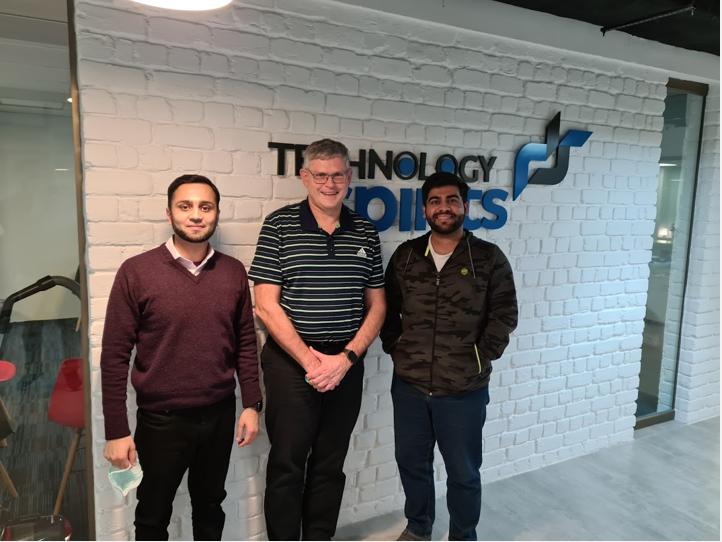
CTO · Technology Spirits
Founded and led Technology Spirits as CTO, delivering enterprise-grade solutions in biometric access control, smart security surveillance, energy management, and embedded hardware for clients across Pakistan and Europe.
2019
President's Gold Medal · MS Robotics, NUST
Earned a Master of Science in Robotics and Intelligent Machine Engineering from NUST with a perfect 4.00 CGPA, graduating with the President's Gold Medal.
2020 — 2026
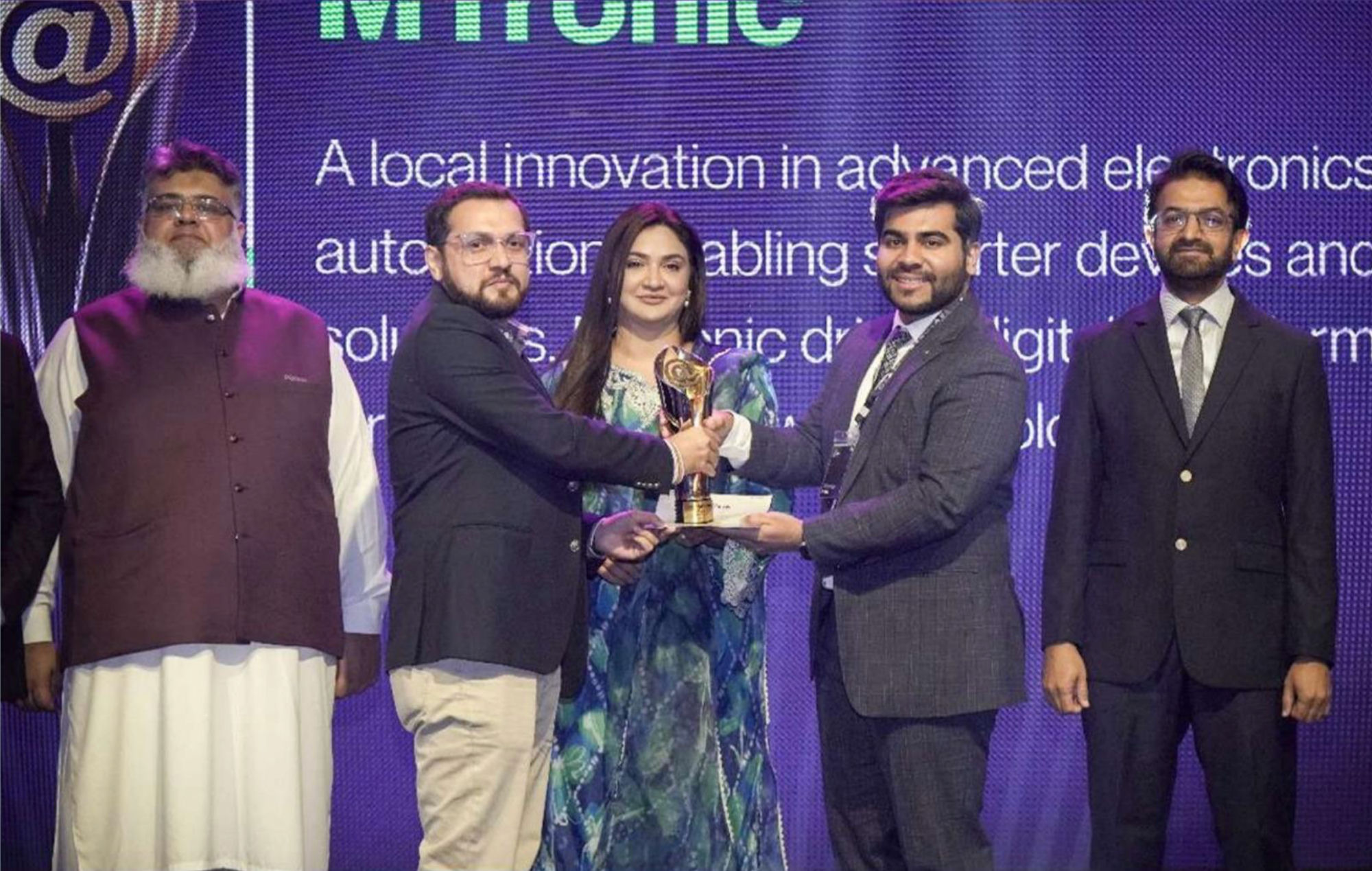
CTO · MRS Technologies & MTronic Pakistan
Formed a joint venture between Technology Spirits and MRS Electronics to establish MRS Technologies, delivering enterprise solutions in embedded systems, smart security, and biometric access control. Grew the company from 24 to 150+ people under his leadership. Also served as CTO of MTronic Pakistan — a home automation company that has delivered over 30,000 smart home devices across Pakistan.
Who Is This For?
Whatever your discipline — this changes how you think.
System design is not a senior-only skill. It is the foundational discipline that makes every engineering speciality more powerful.
You were taught algorithms. Nobody taught you what runs in production.
A CS degree gives you the vocabulary. System design gives you the sentence.
The Problem
- You can balance a red-black tree blindfolded — but freeze when asked why a B-tree index outperforms a hash index for range queries in PostgreSQL.
- Your university taught distributed computing theory. It never showed you what happens when a node fails mid-write in a replicated system under network partition.
- Every candidate has the same degree. The ones who get offers are those who reason about systems, not just algorithms.
What Changes
- Connect your CS fundamentals — consistency models, consensus, CAP — to real architectural decisions at companies like Google and Meta.
- Walk into technical interviews and design systems that interviewers remember, not just pass.
- Build the mental model that turns academic theory into real engineering judgment.
“Your degree is the foundation. System design is the building.”
“Your degree is the foundation. System design is the building.”
Join the Masterclass →Beyond the Sessions
Do the work. Earn the proof.
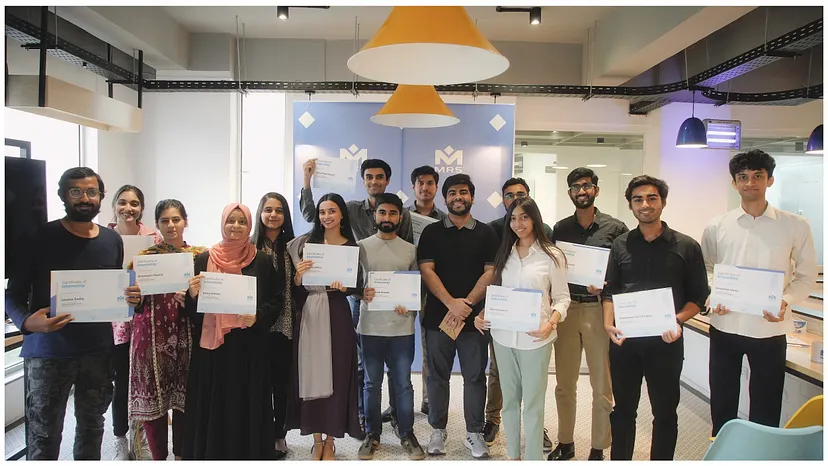
Every cohort member completes four weekly assignments and one capstone project. Finish both, and you walk away with something tangible.
System Design Masterclass
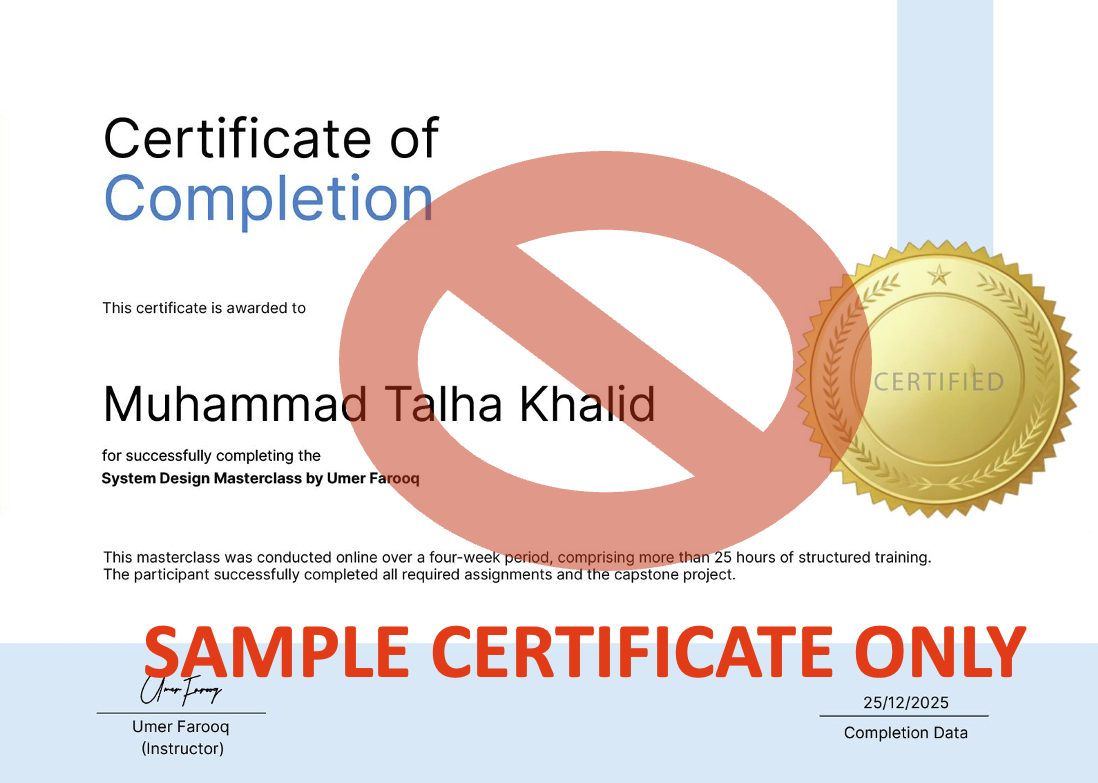
Certificate of Completion
This certificate is issued to every student who completes all four weekly assignments and presents their capstone project live to the cohort. It recognises not just attendance, but demonstrated ability to design real systems at scale.
Requirements
4 assignments + capstone presentation
Format
Digital · Shareable · Verifiable
Issued by
Umer Farooq · System Design Masterclass
Share on
LinkedIn · Portfolio · Resume
Earned · Not Given
4 Weekly Assignments
1 Capstone Project
Instructor Feedback
Past Cohort Work
Real projects from real students.
Actual capstone submissions from previous cohorts. Click any to download and see the depth of thinking we expect.
PDF · Click to download
Cohort 5
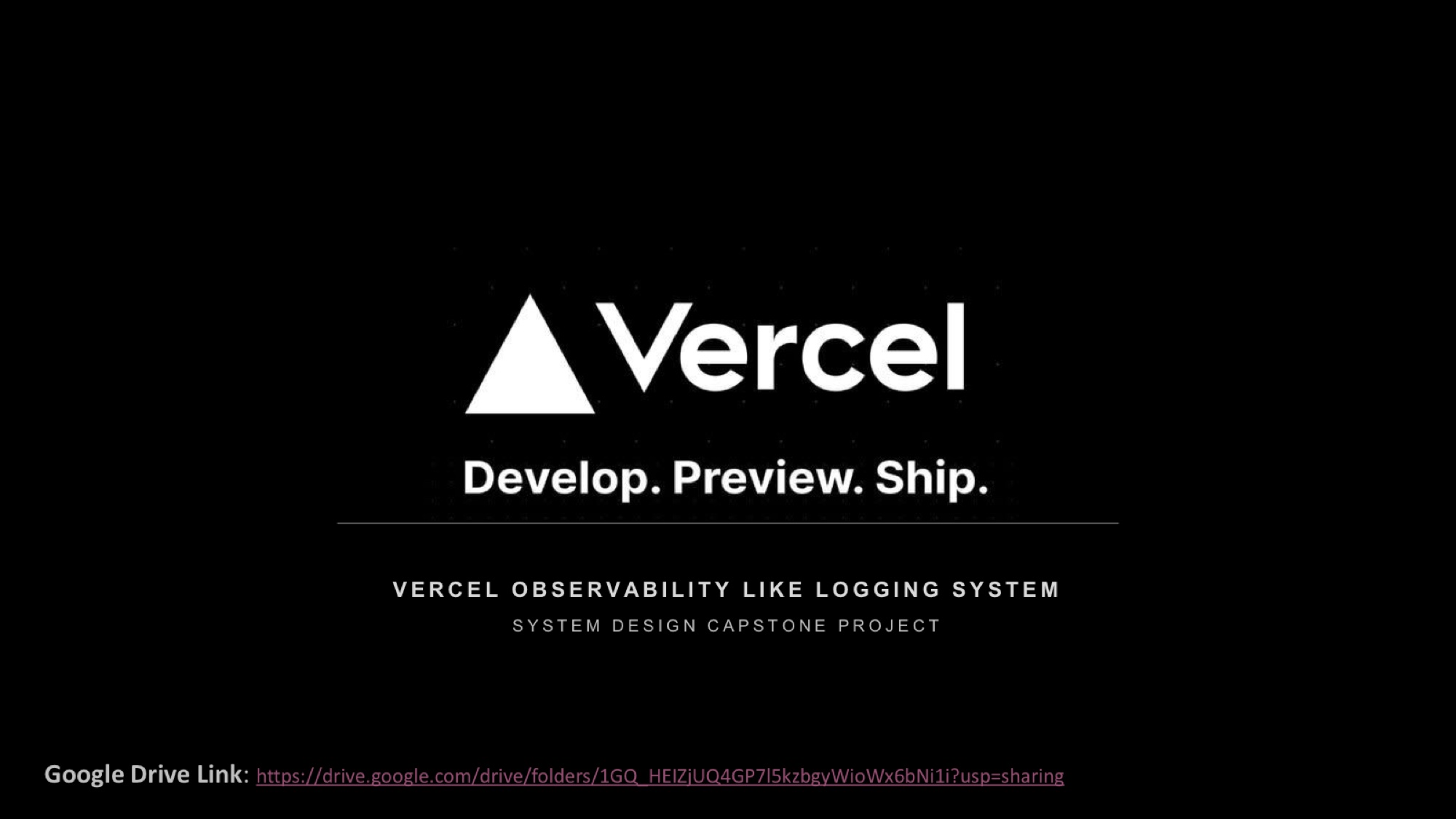
Log Stream — Vercel-Style Observability
Ammaar Naveed
Log ingestion · Stream processing · Storage tiering
Cohort 5
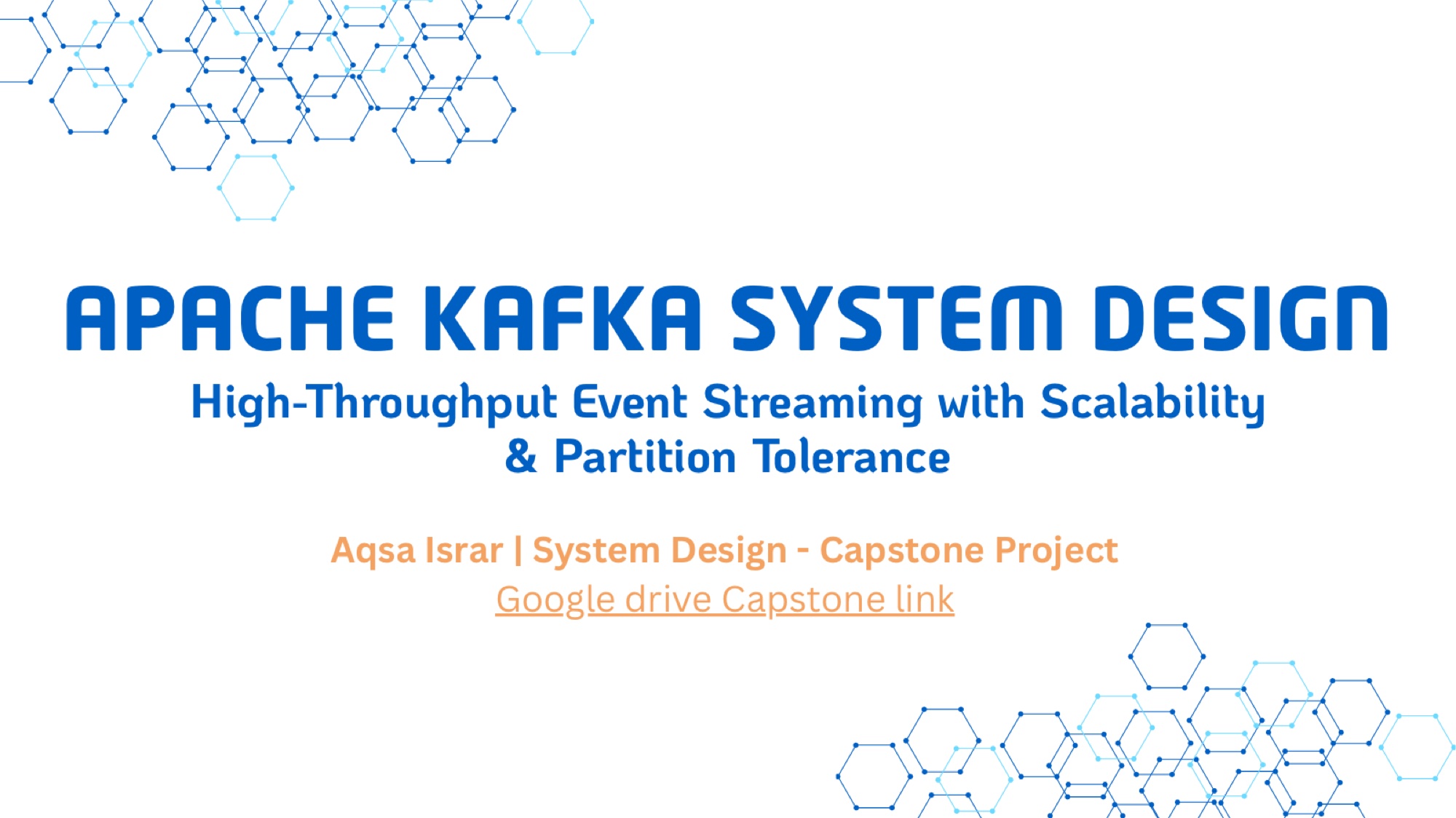
Apache Kafka System Design
Aqsa Israr
High-throughput events · Partition tolerance · Consumer groups
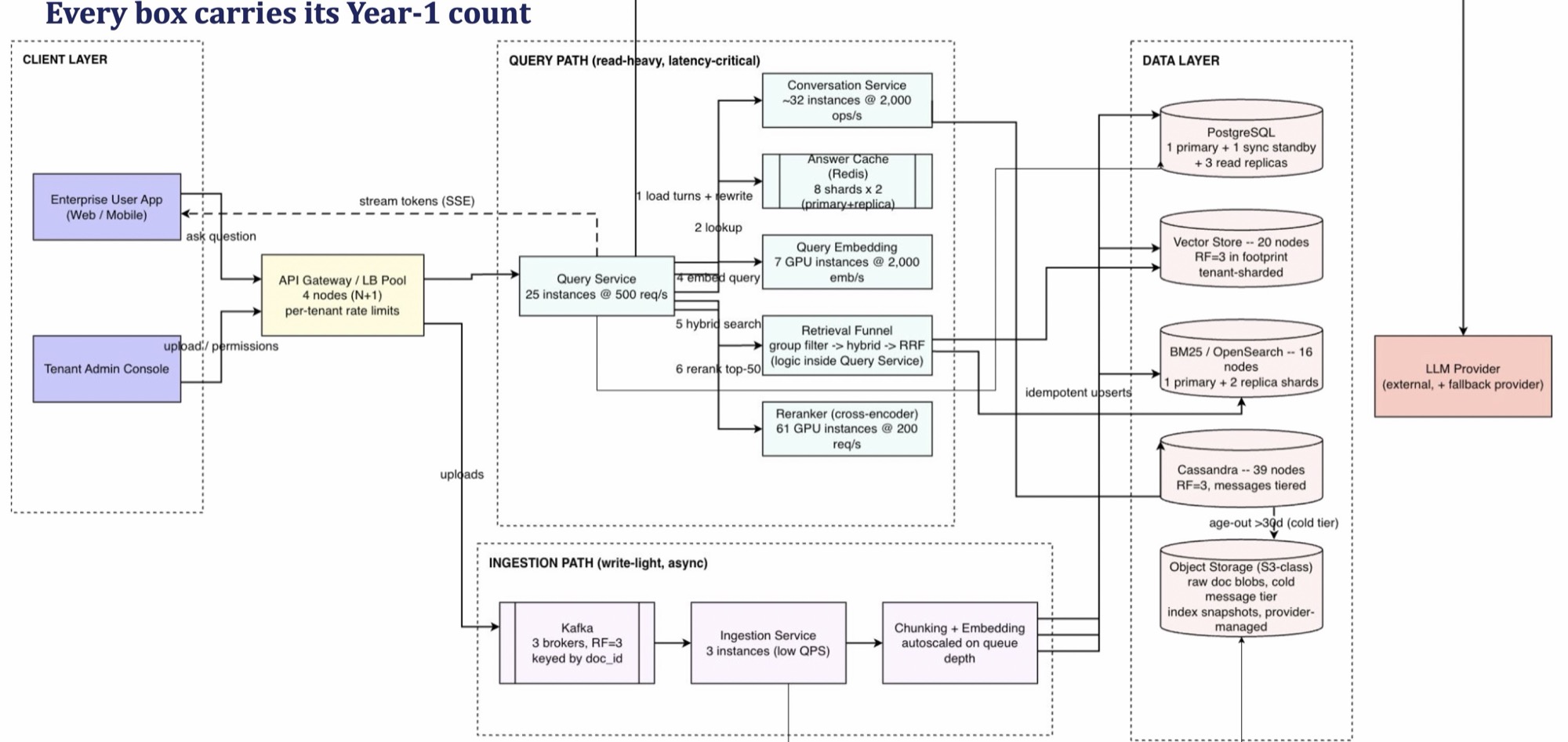
Cohort 4
Multi-Tenant Enterprise RAG Platform
Muneeb Yasin & Zeeshan Hamid
Tenant isolation · Hybrid retrieval · Vector store
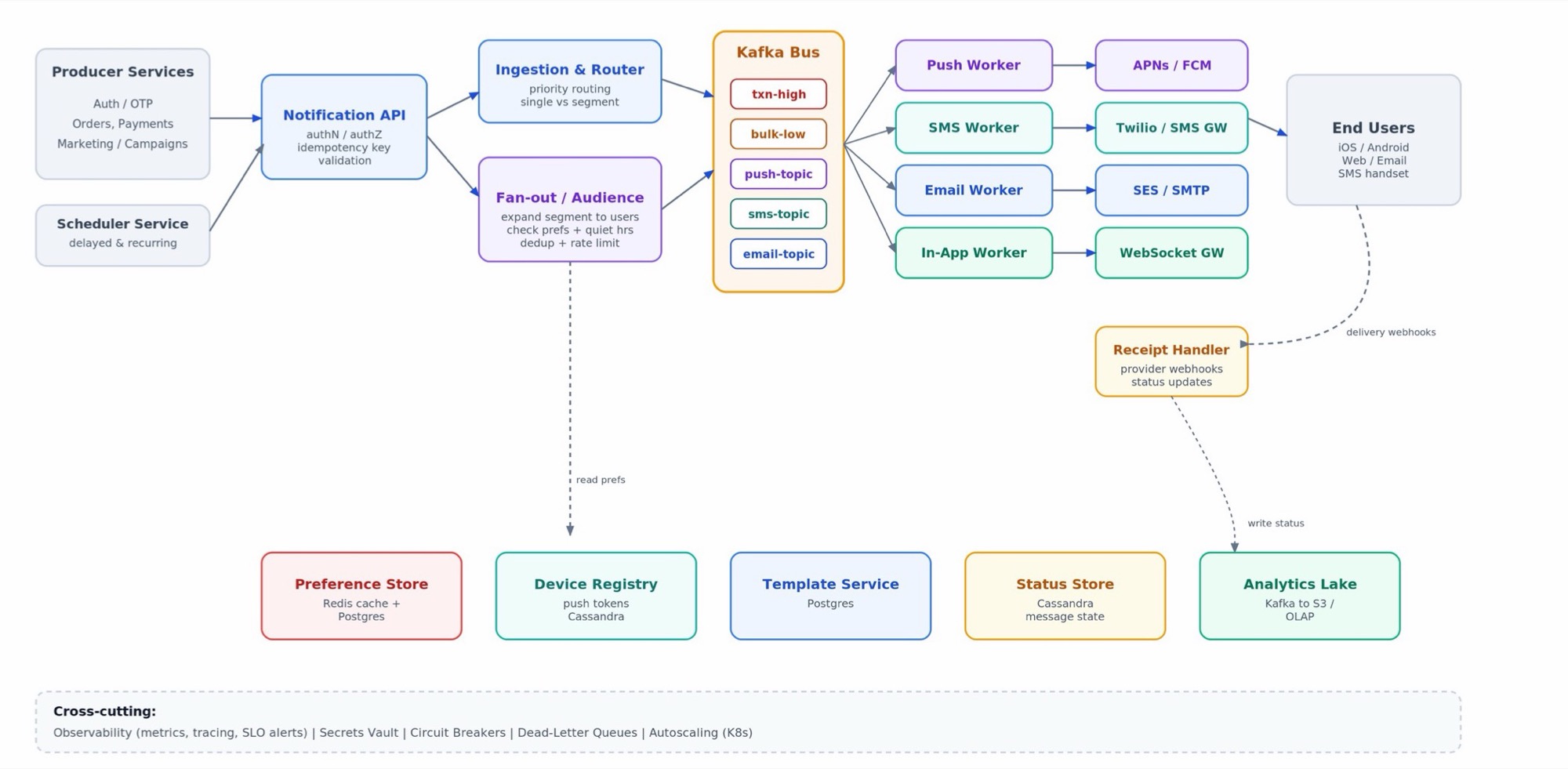
Cohort 4
Planet-Scale Notification & Push
Yahya Ahmed
Kafka priority topics · Fan-out · Multi-channel
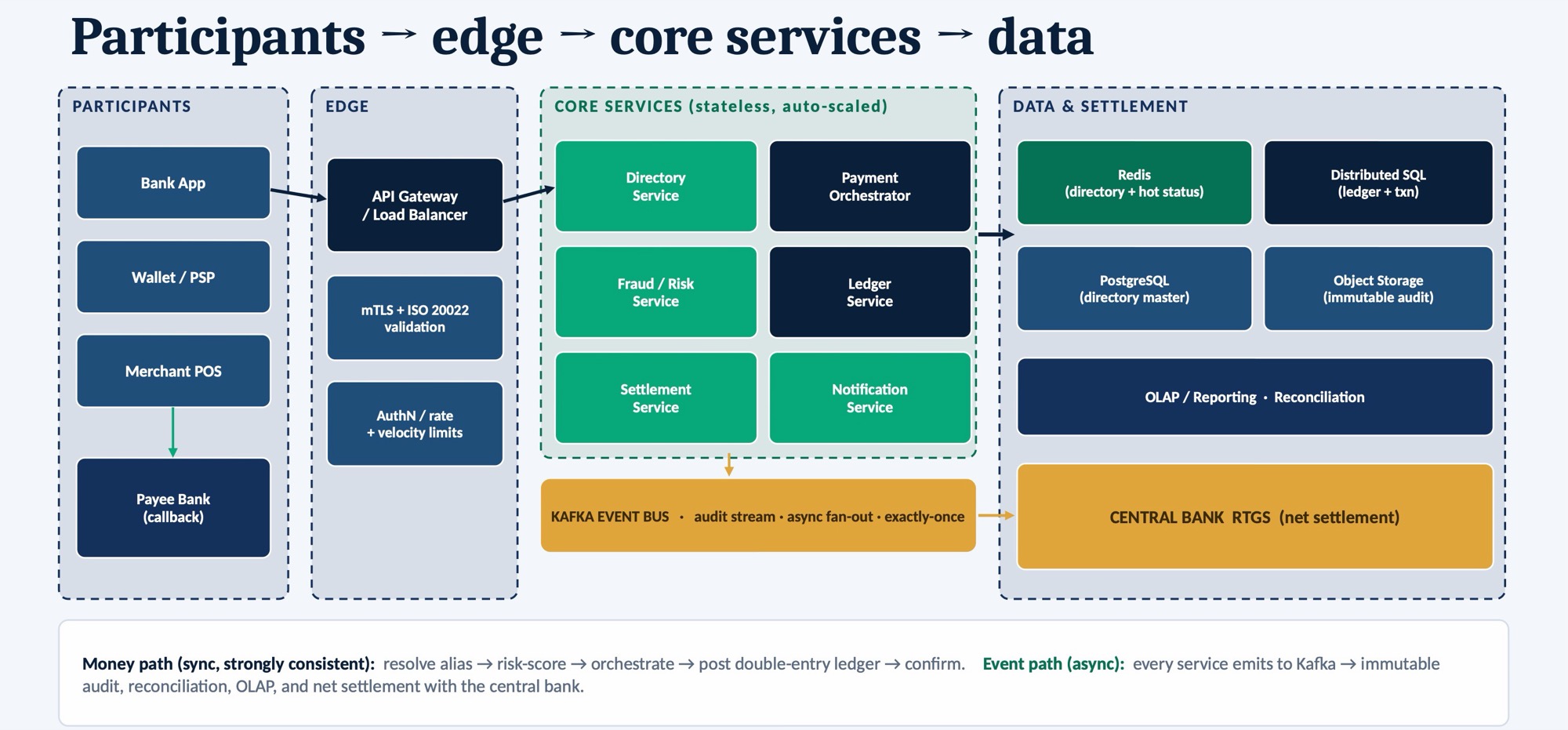
Cohort 4
National Instant Payment Rail
Umer Qasim
Double-entry ledger · ISO 20022 · Idempotency
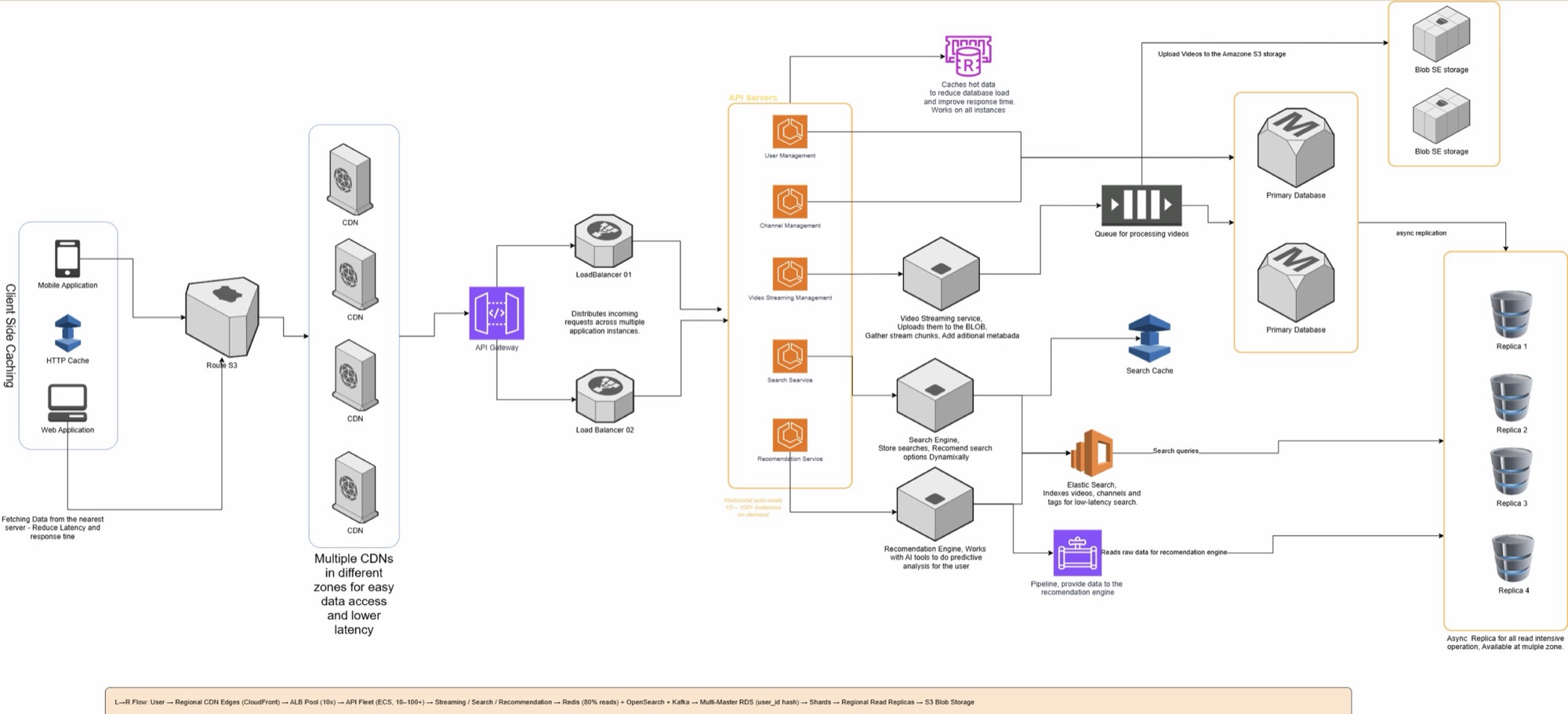
Cohort 4
YouTube System Design
Hajra Zahid
800M MAU · Multi-CDN · Adaptive bitrate
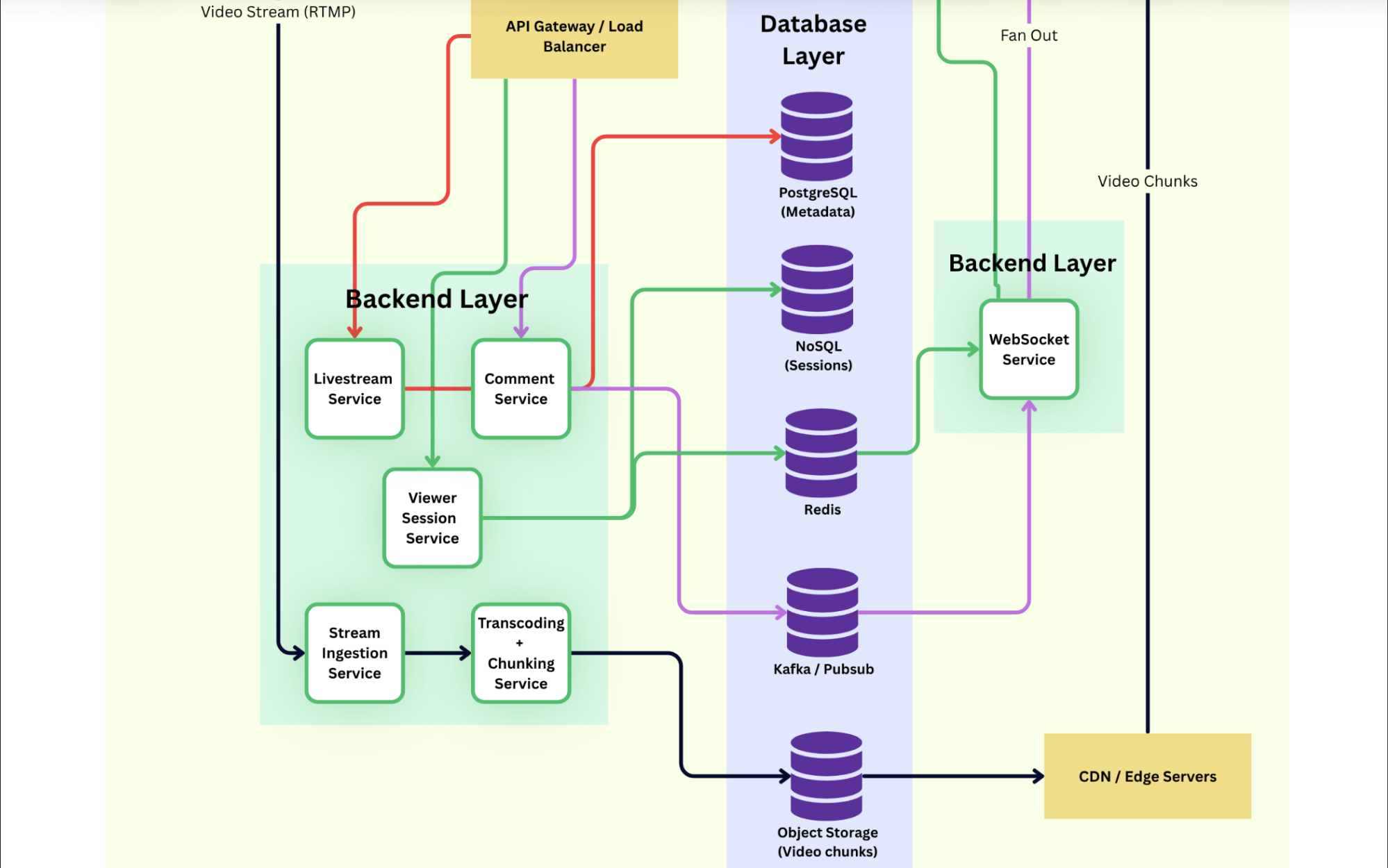
Cohort 3
Instagram Live
Jawad Ahmed Khan & Samee Haider
RTMP · WebSockets · Kafka

Cohort 3
How Spotify Streams to 700M
Aqsa Hussain
CDN · Adaptive bitrate · Content delivery

Cohort 3
How Uber Finds Nearby Drivers
Hafsa Hassan & Khadija Saleem
Geo-indexing · Real-time dispatch · WebSockets
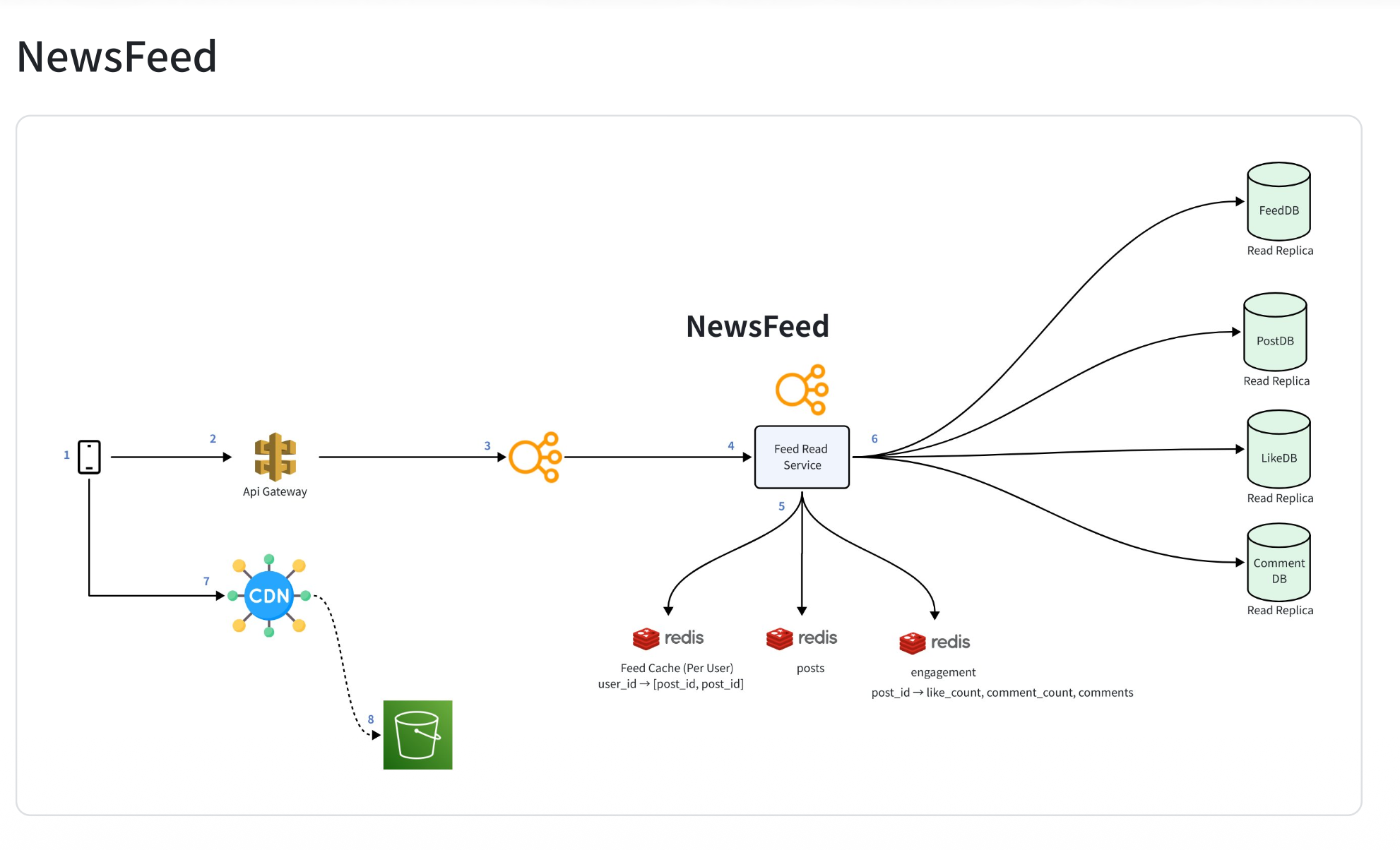
Cohort 2
Instagram Newsfeed Design
Bilawal Khan
Fan-out · Redis cache · Sharding
Swipe to see more →
Cohort 5
Log Stream — Vercel-Style Observability
Ammaar Naveed
Log ingestion · Stream processing · Storage tiering
Cohort 5
Apache Kafka System Design
Aqsa Israr
High-throughput events · Partition tolerance · Consumer groups
Cohort 4
Multi-Tenant Enterprise RAG Platform
Muneeb Yasin & Zeeshan Hamid
Tenant isolation · Hybrid retrieval · Vector store
Cohort 4
Planet-Scale Notification & Push
Yahya Ahmed
Kafka priority topics · Fan-out · Multi-channel
Cohort 4
National Instant Payment Rail
Umer Qasim
Double-entry ledger · ISO 20022 · Idempotency
Cohort 4
YouTube System Design
Hajra Zahid
800M MAU · Multi-CDN · Adaptive bitrate
Cohort 3
Instagram Live
Jawad Ahmed Khan & Samee Haider
RTMP · WebSockets · Kafka
Cohort 3
How Spotify Streams to 700M
Aqsa Hussain
CDN · Adaptive bitrate · Content delivery
Cohort 3
How Uber Finds Nearby Drivers
Hafsa Hassan & Khadija Saleem
Geo-indexing · Real-time dispatch · WebSockets
Cohort 2
Instagram Newsfeed Design
Bilawal Khan
Fan-out · Redis cache · Sharding
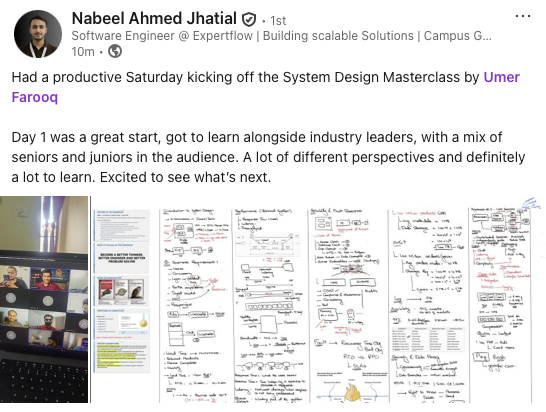
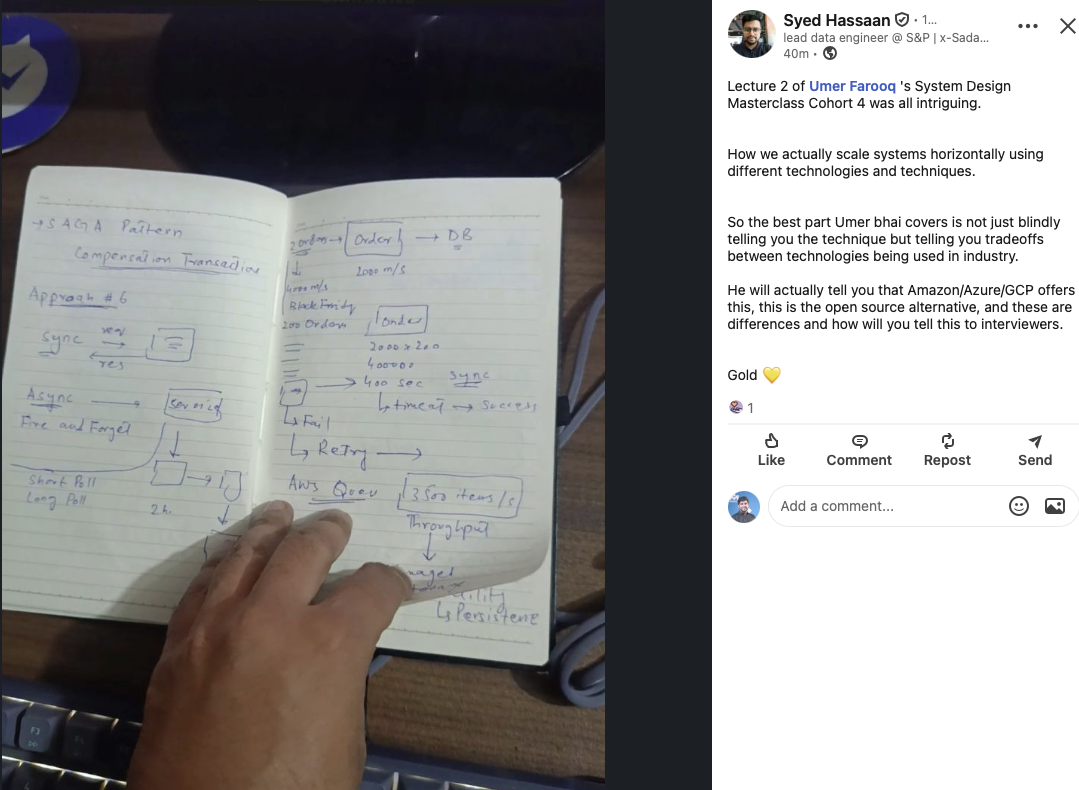
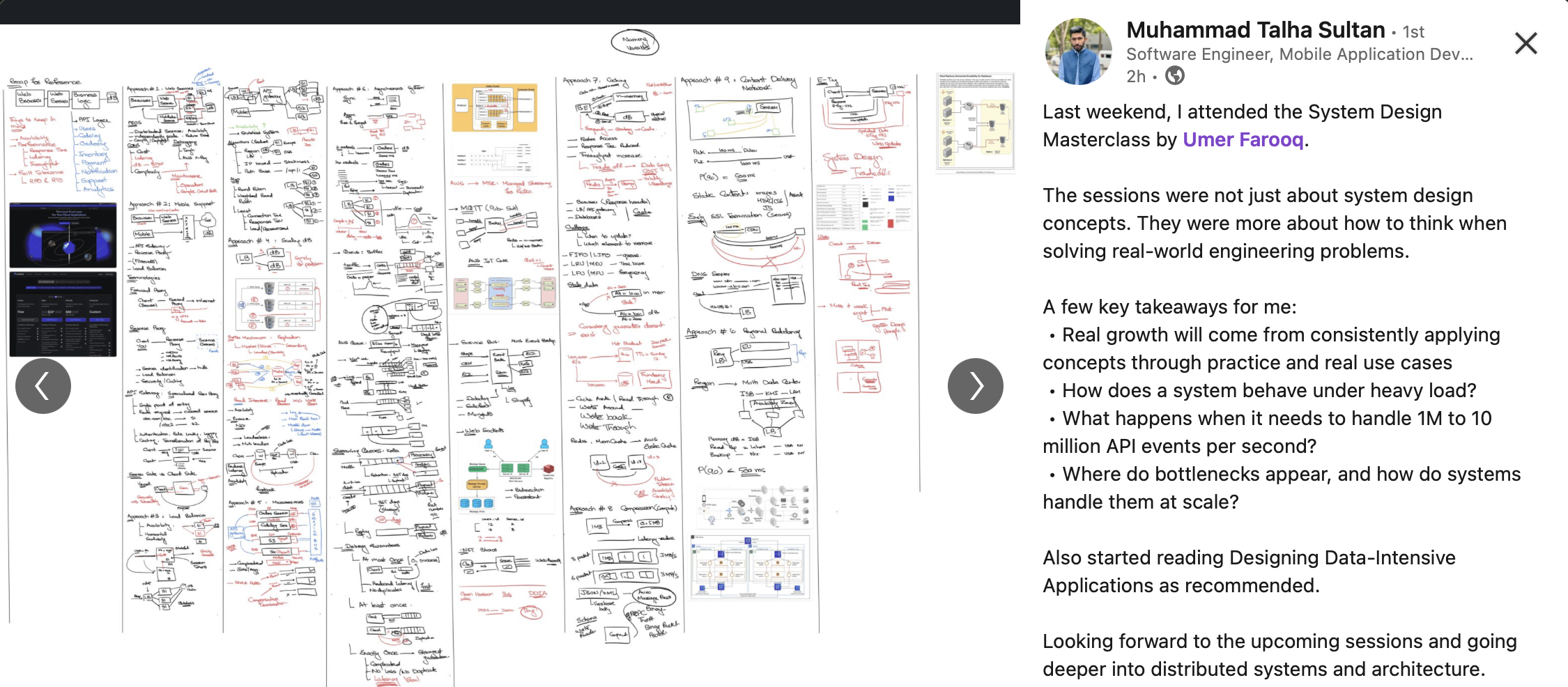
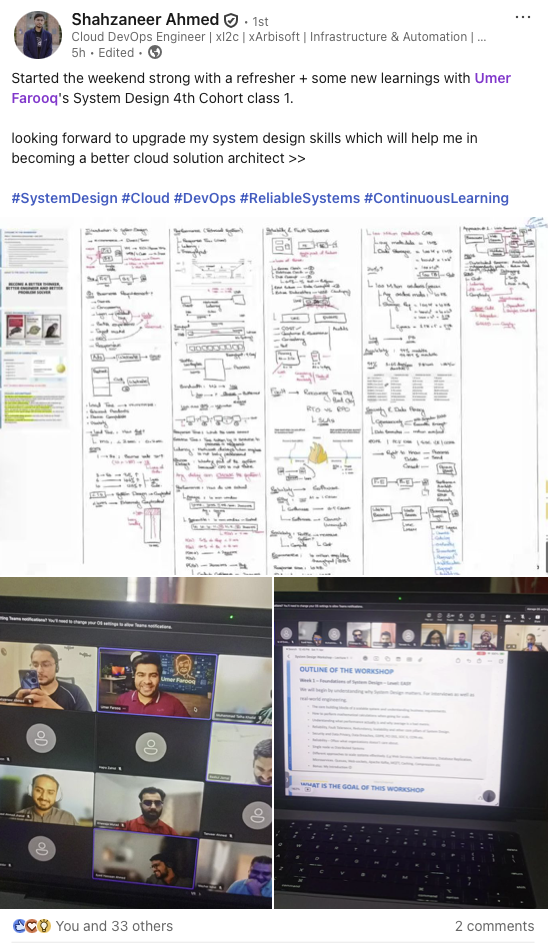
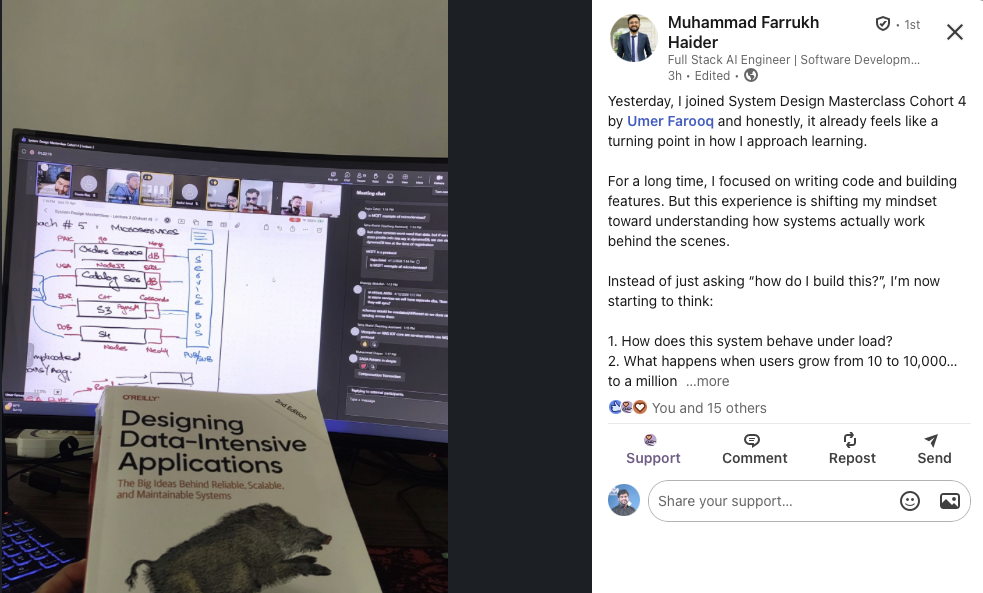
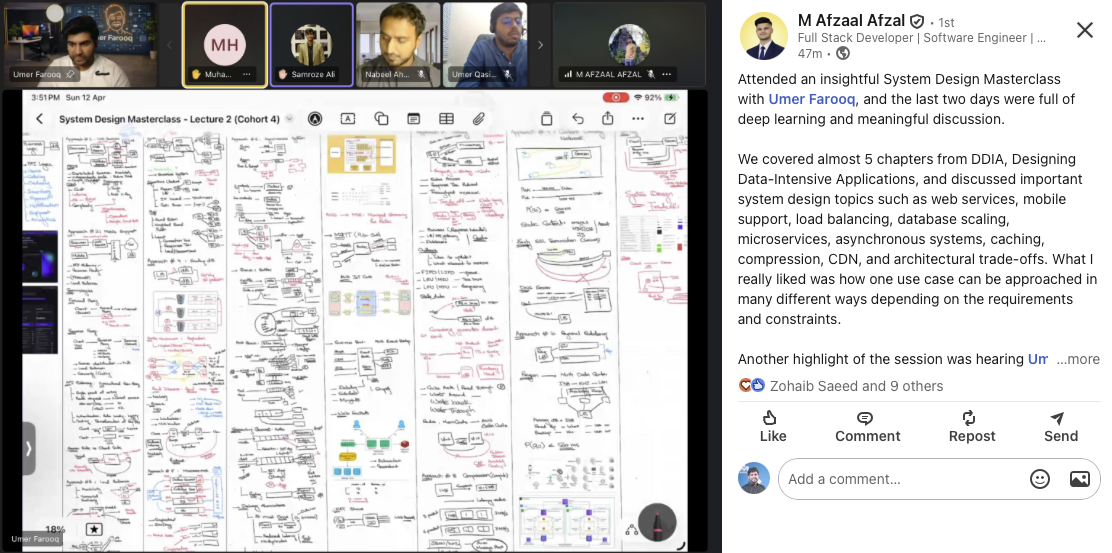
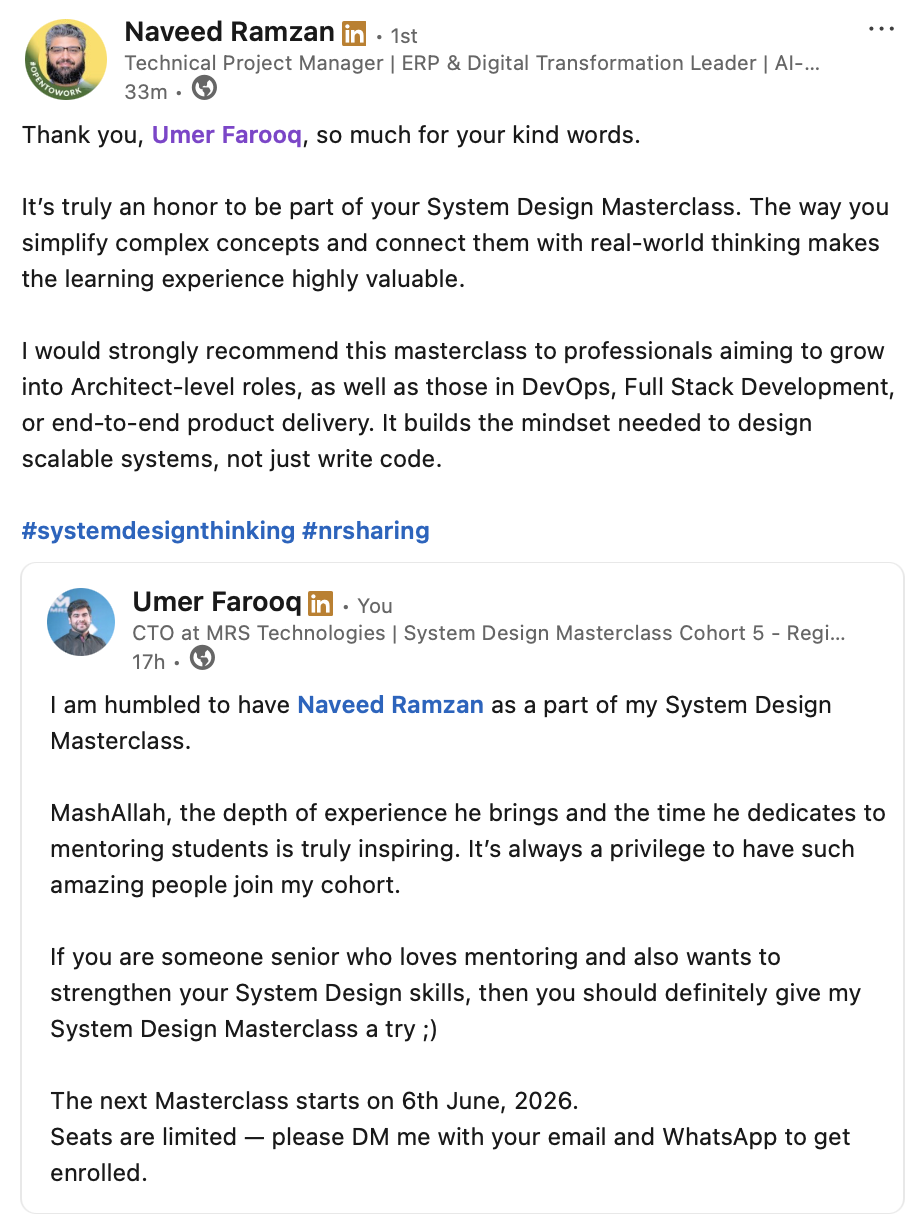
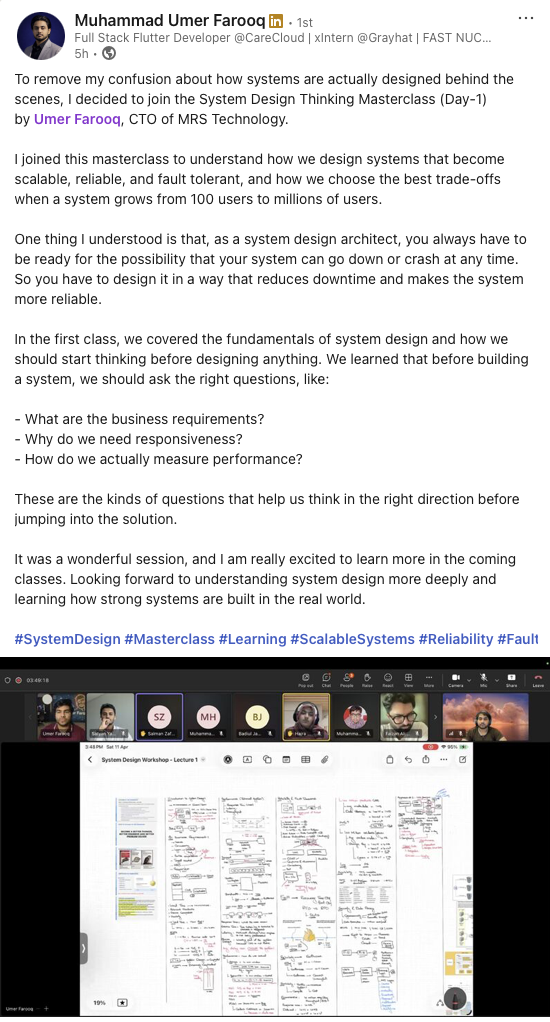
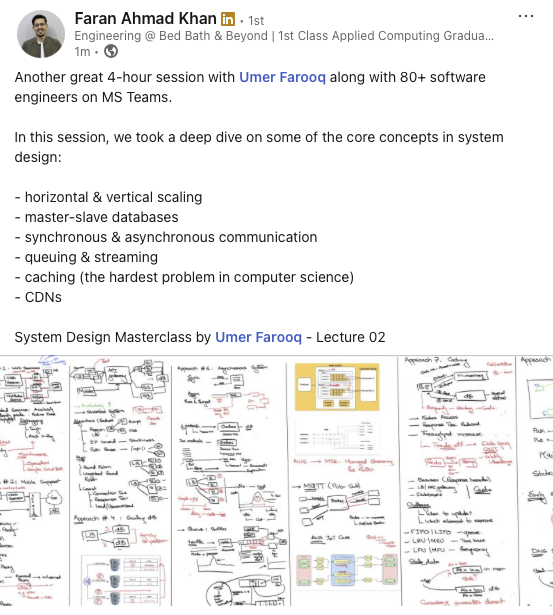
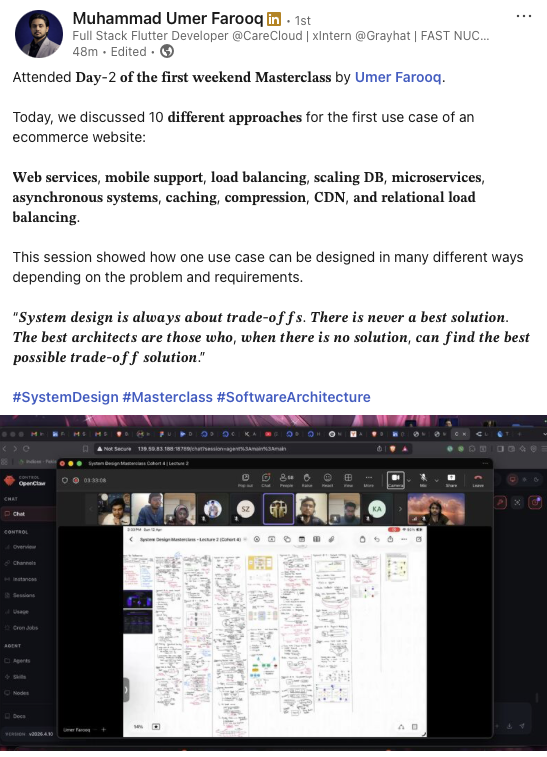
From the Community
What past students are saying.
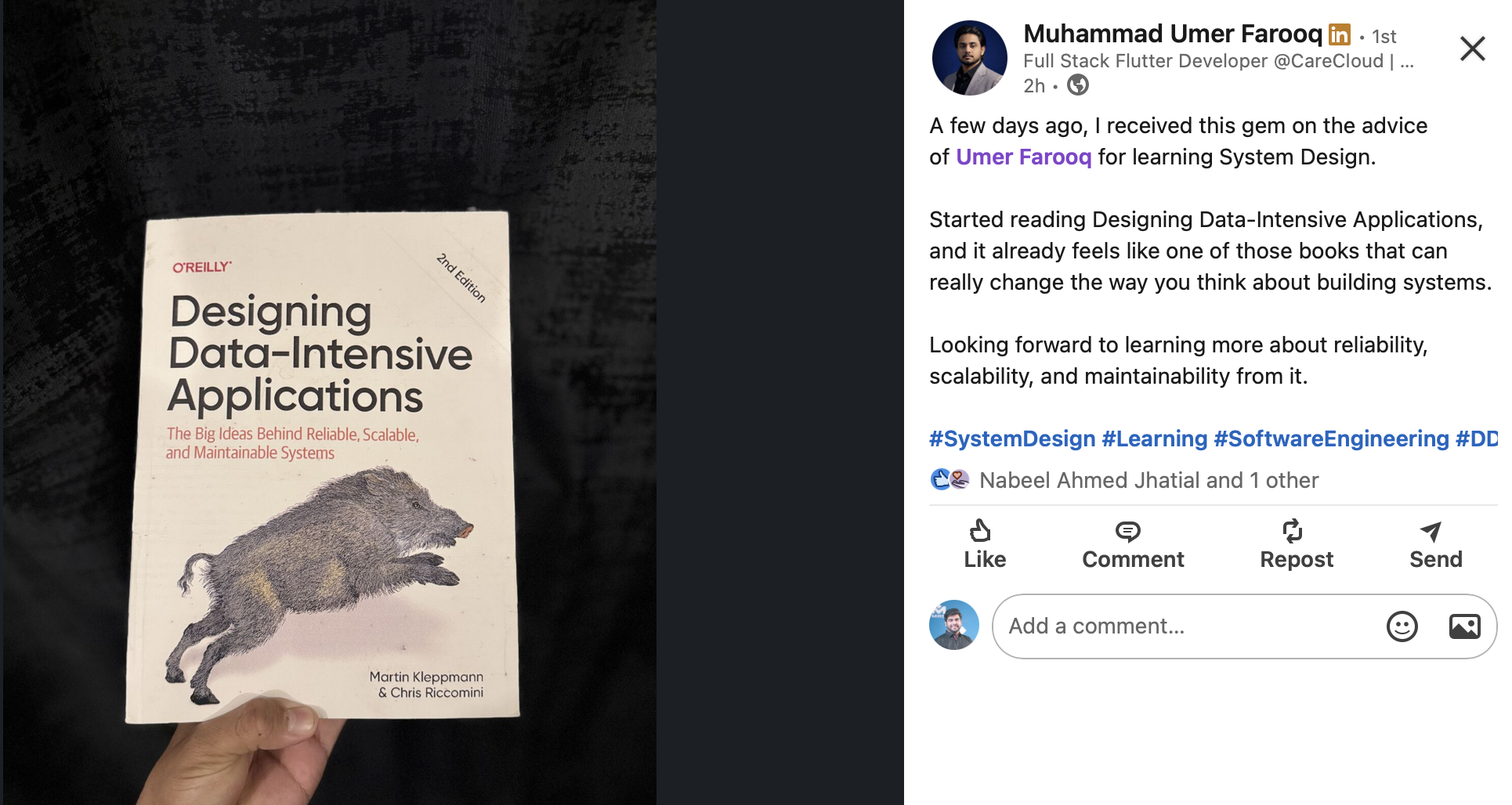
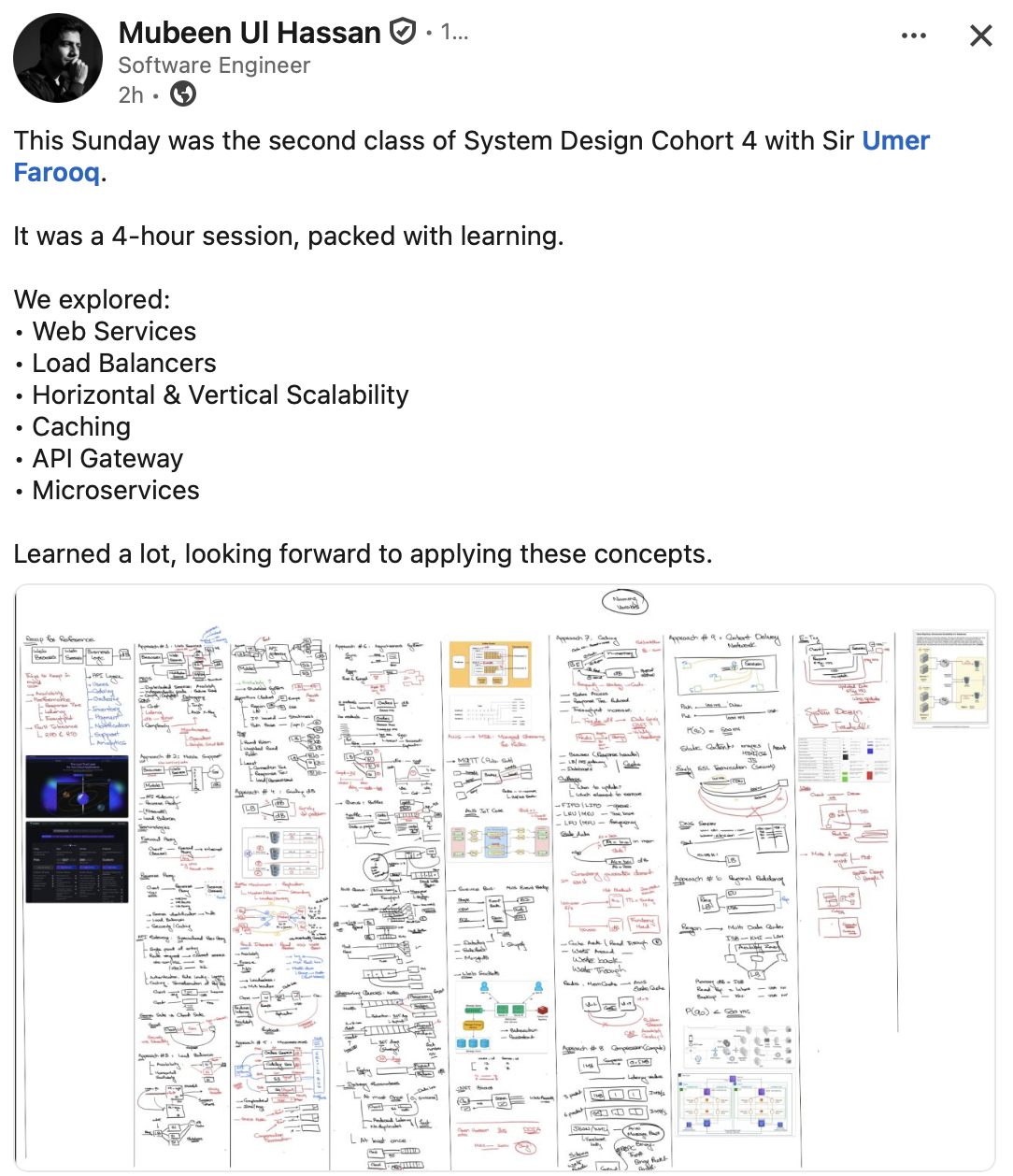
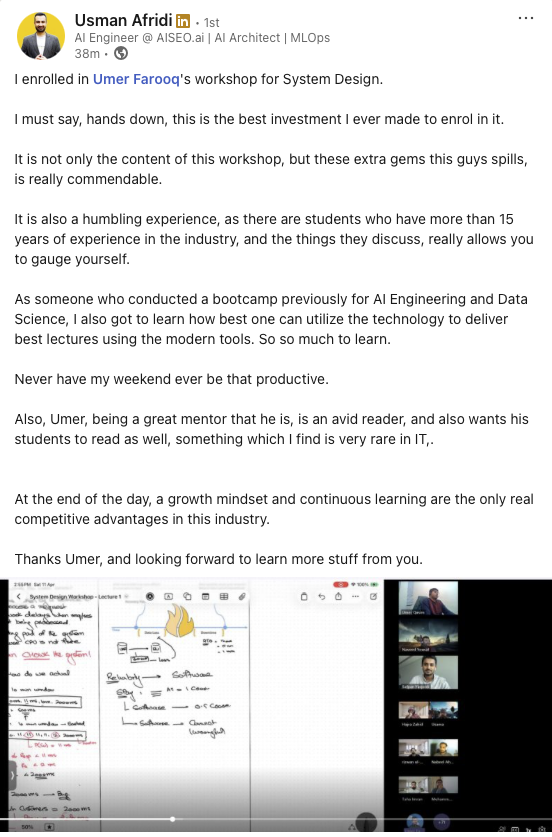
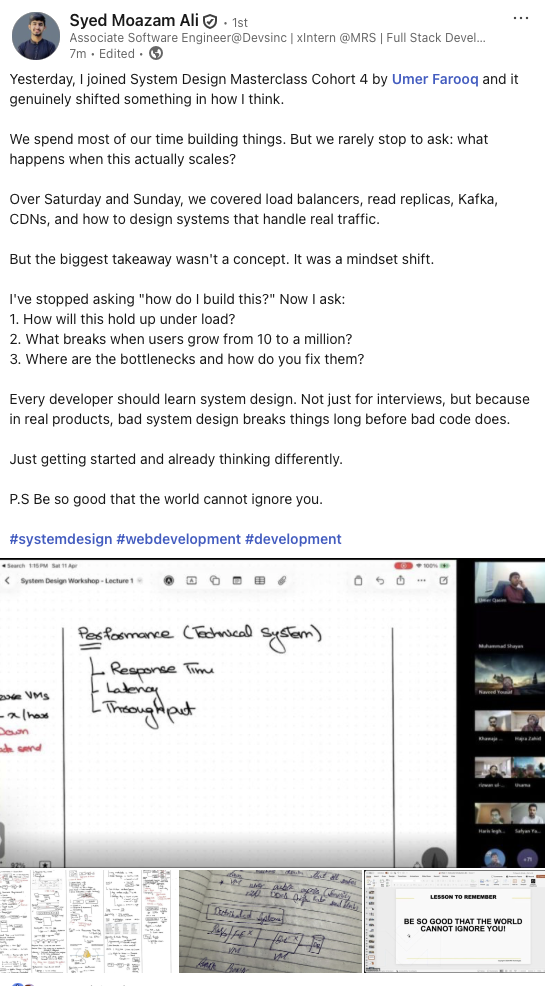
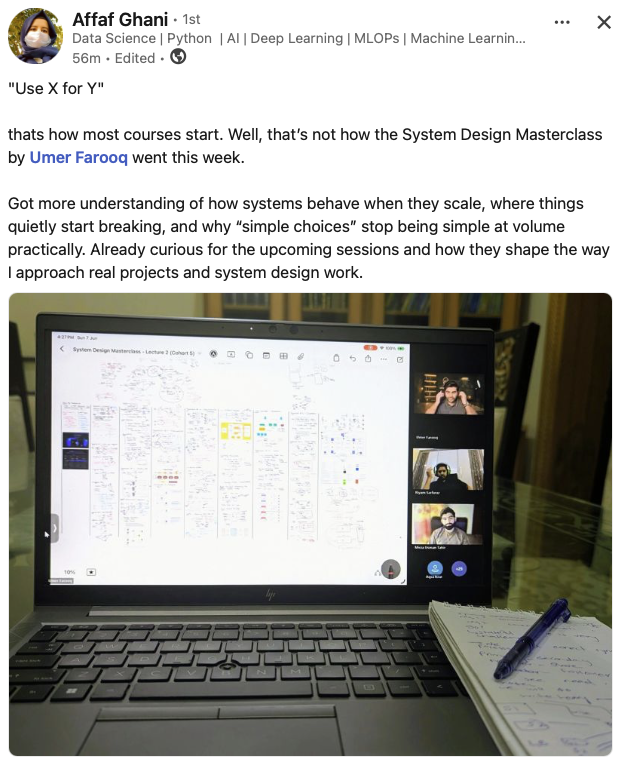
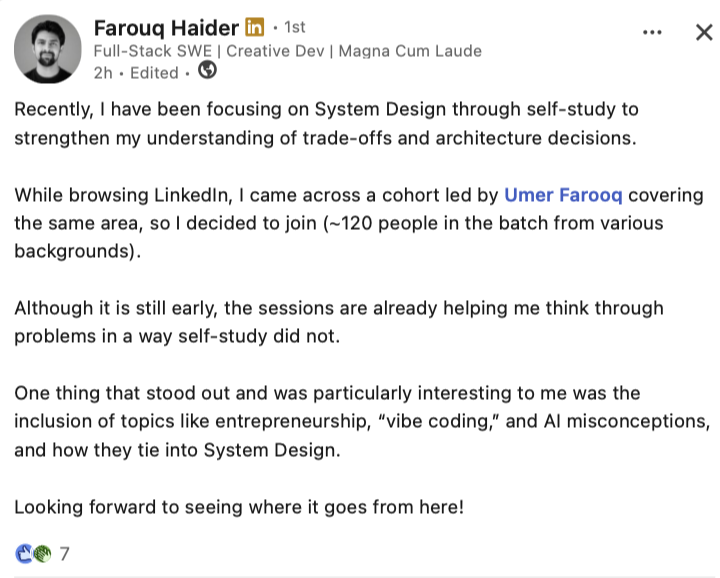
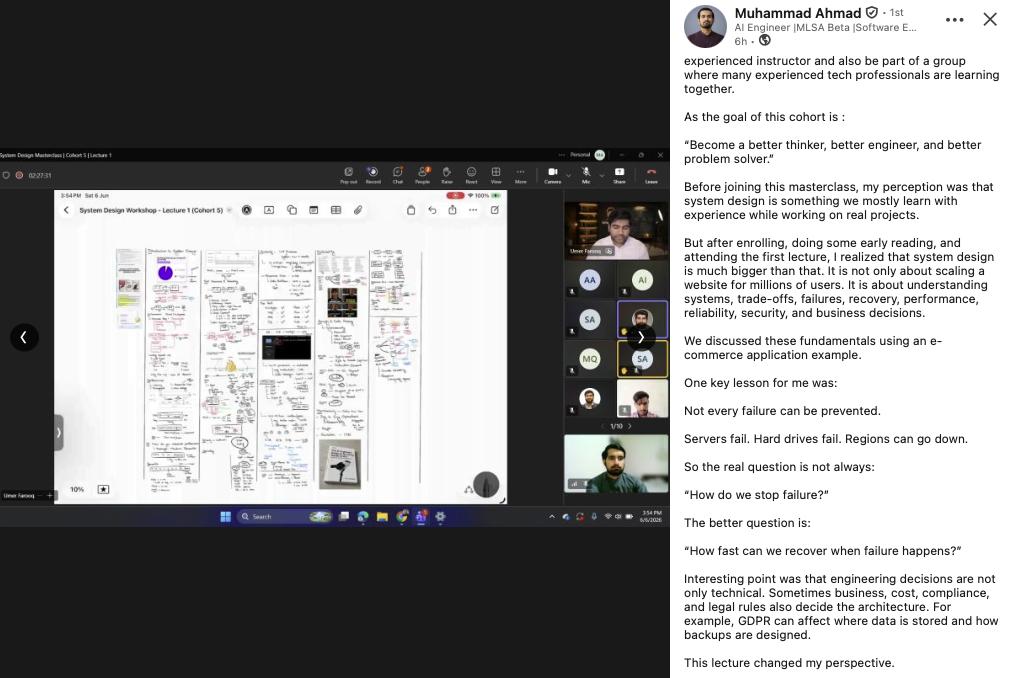
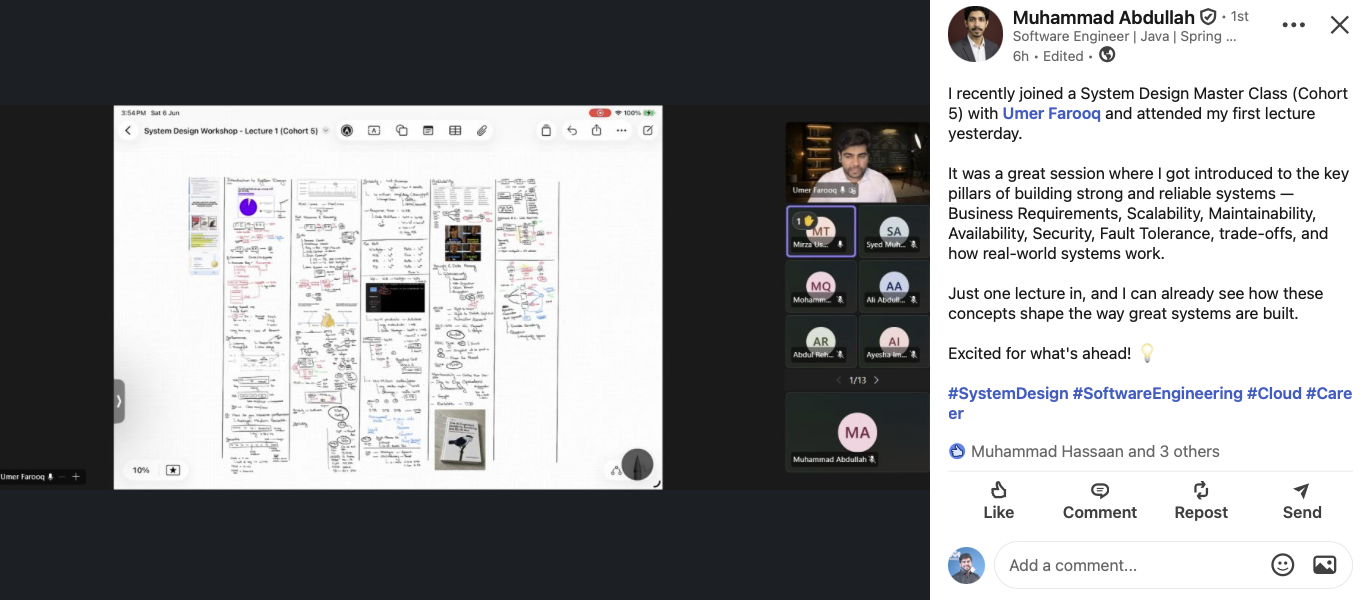
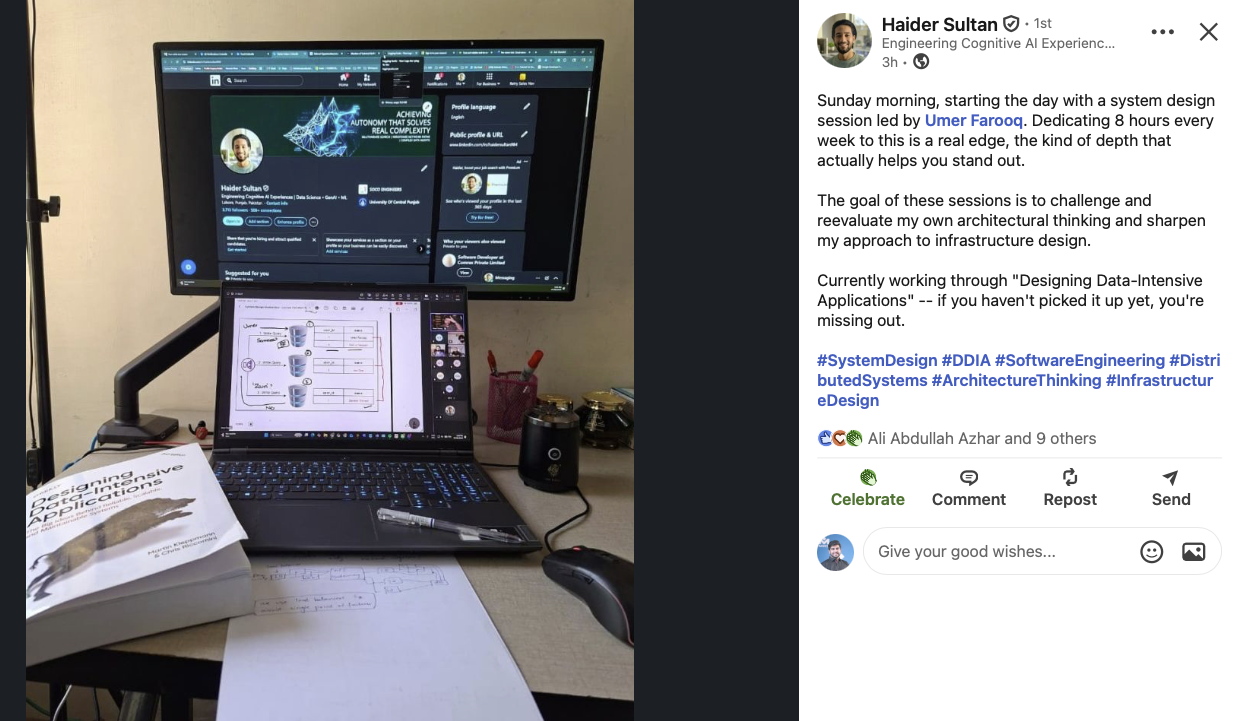
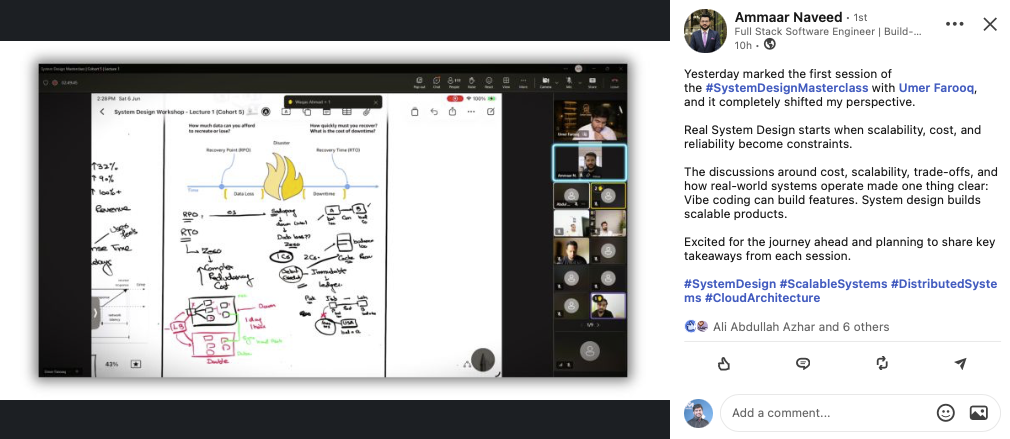
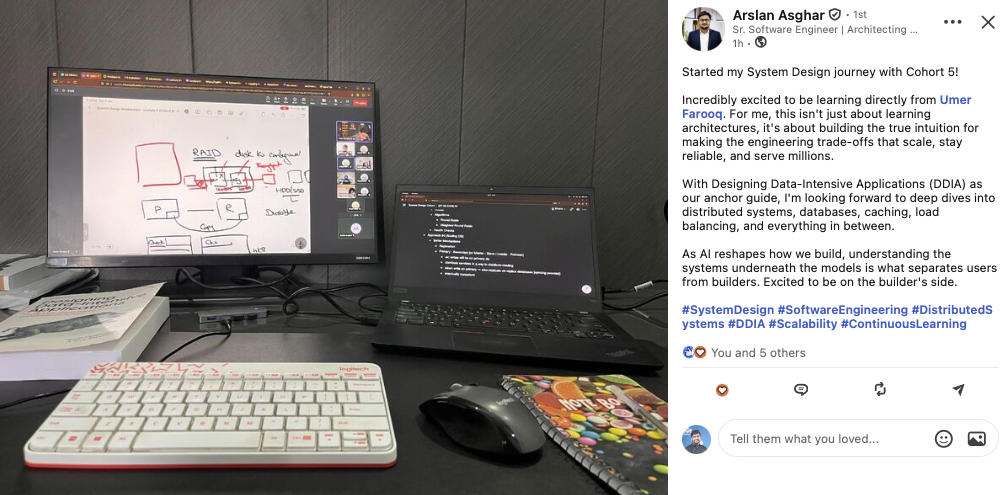
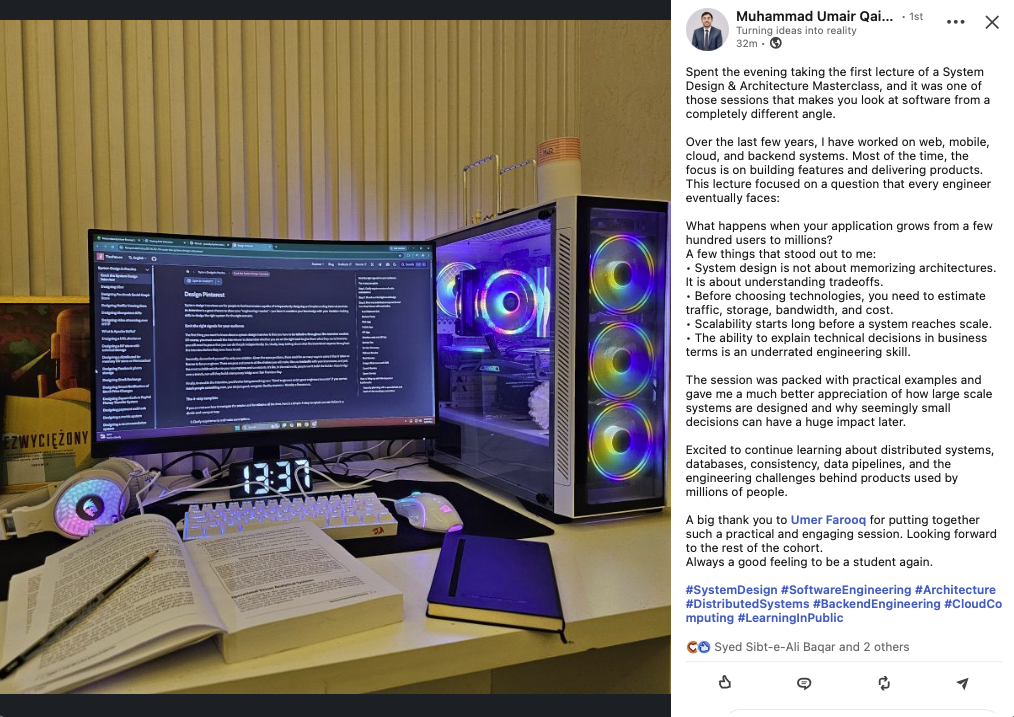
Real feedback from engineers who went through the same journey. Click any card to view full size.
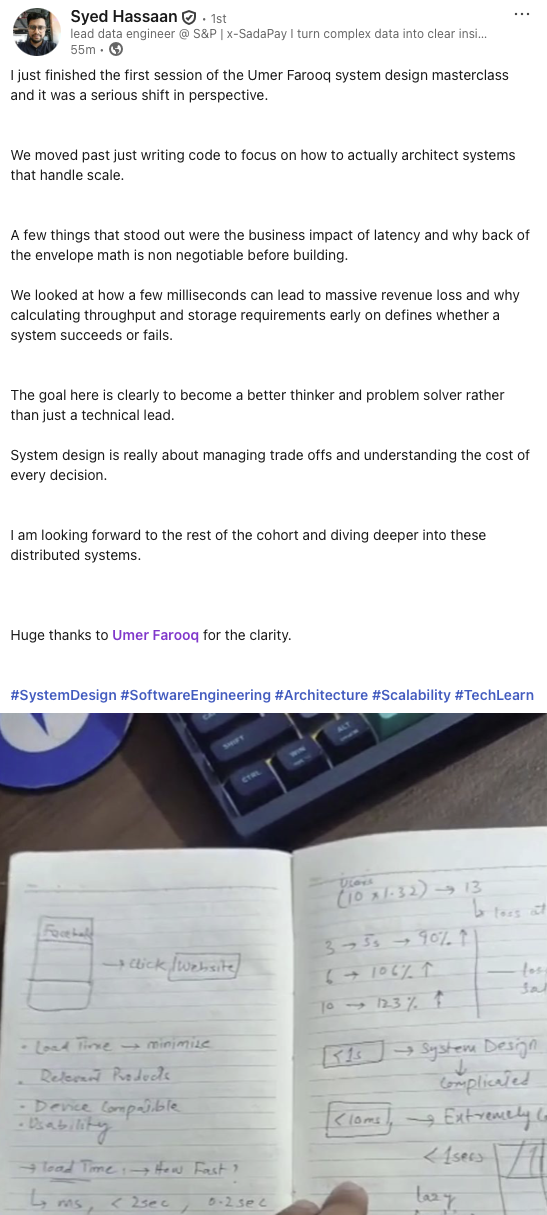
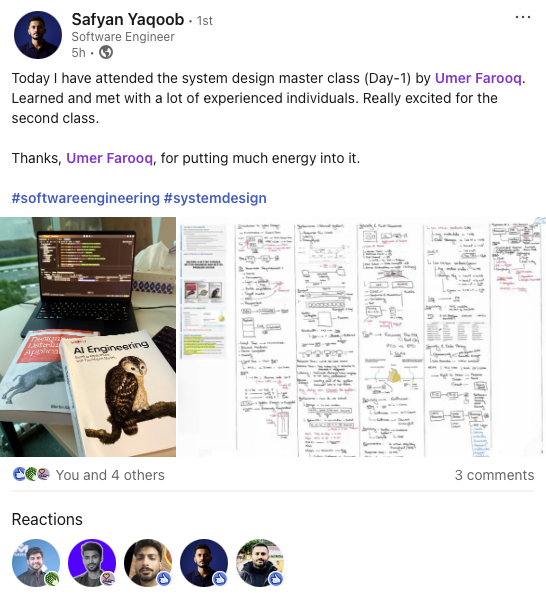
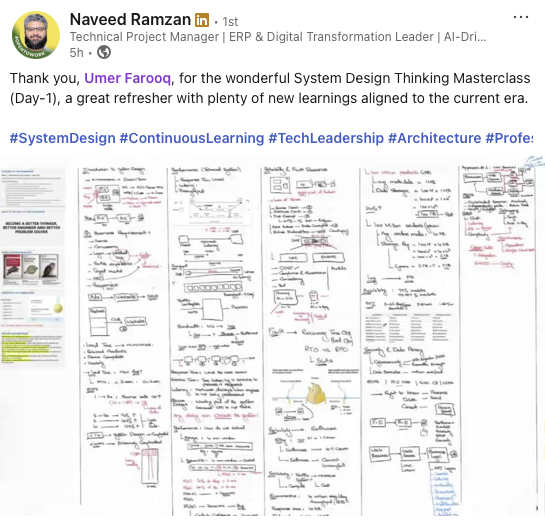
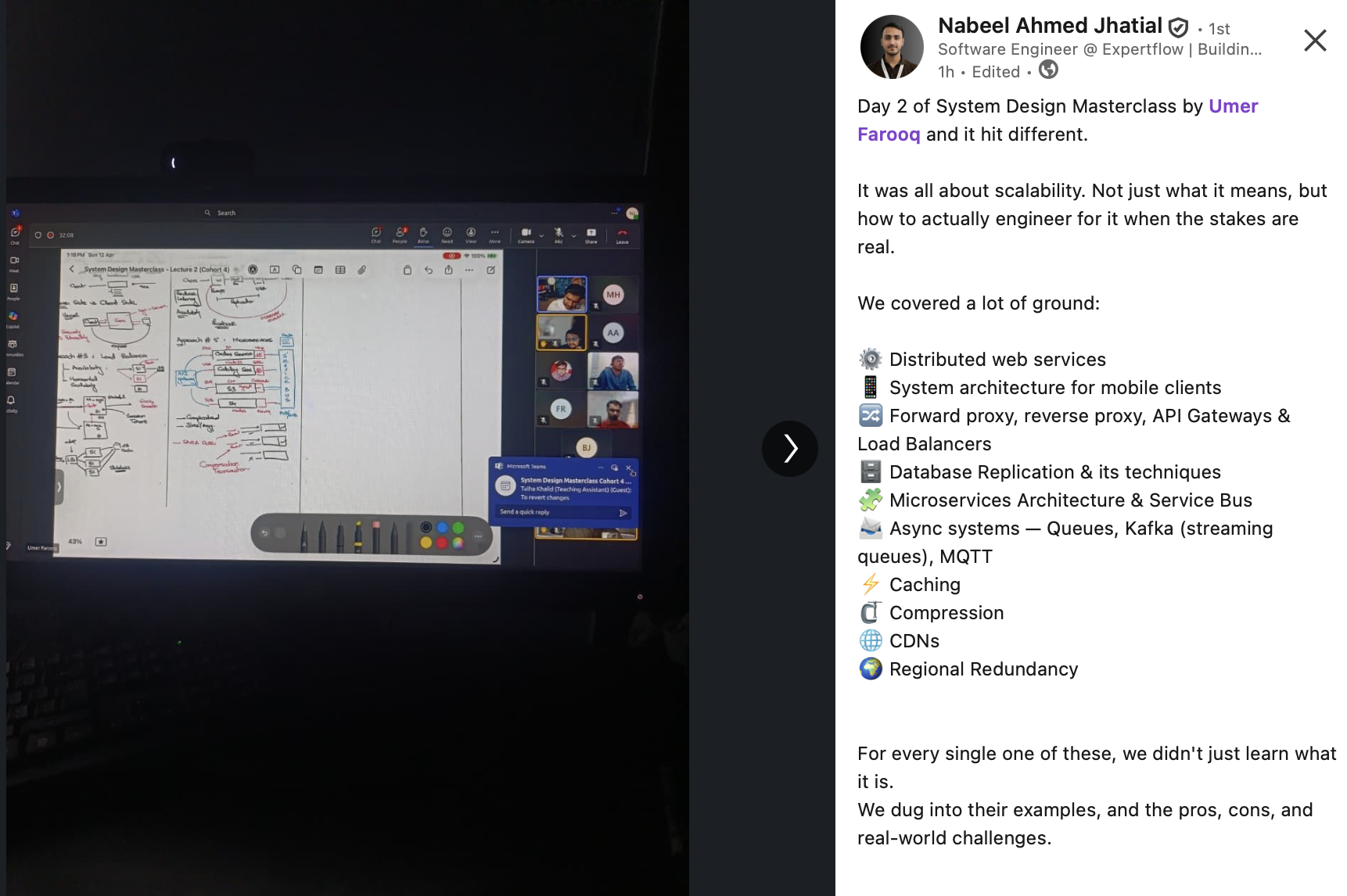
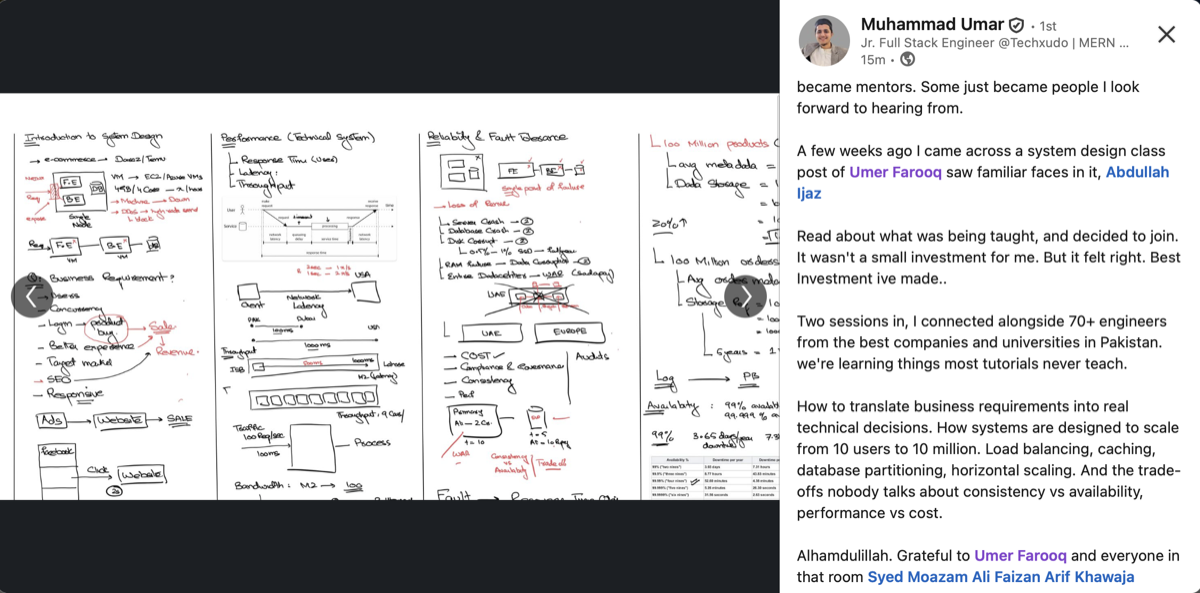
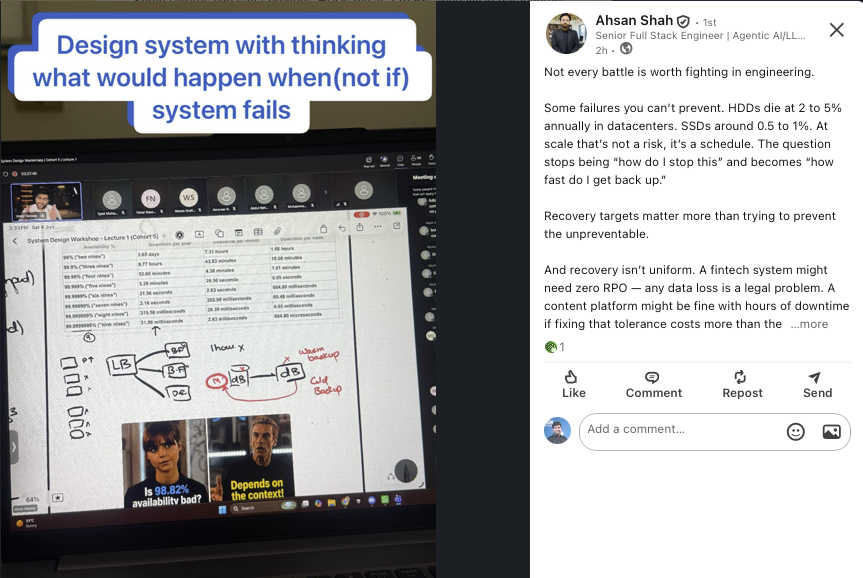
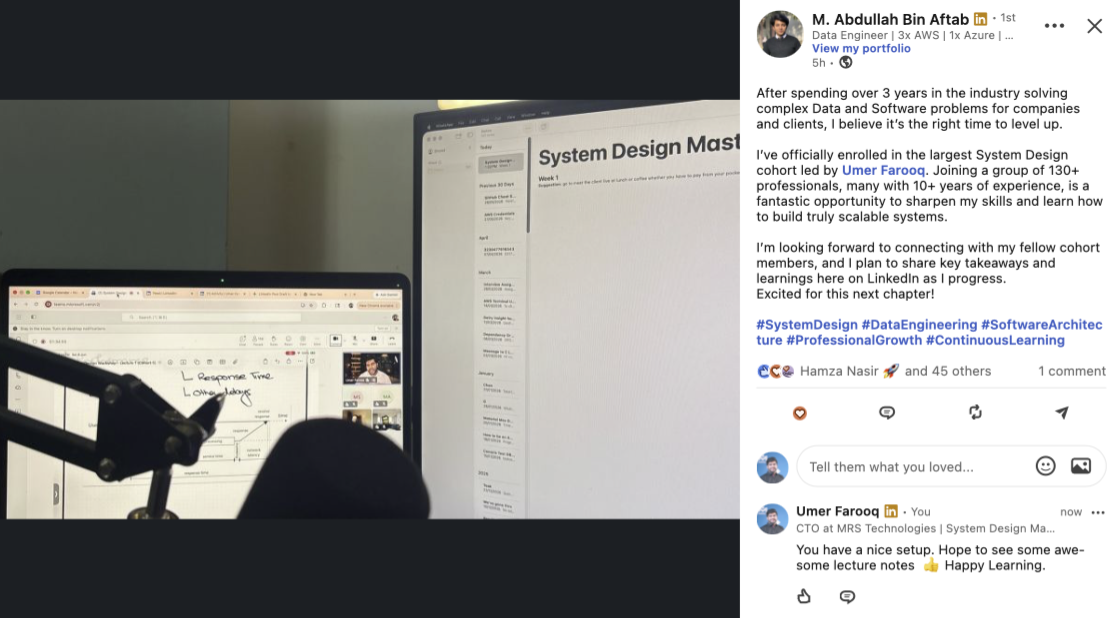
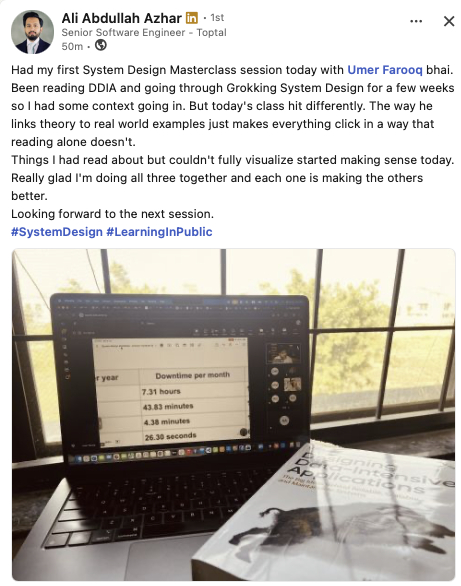
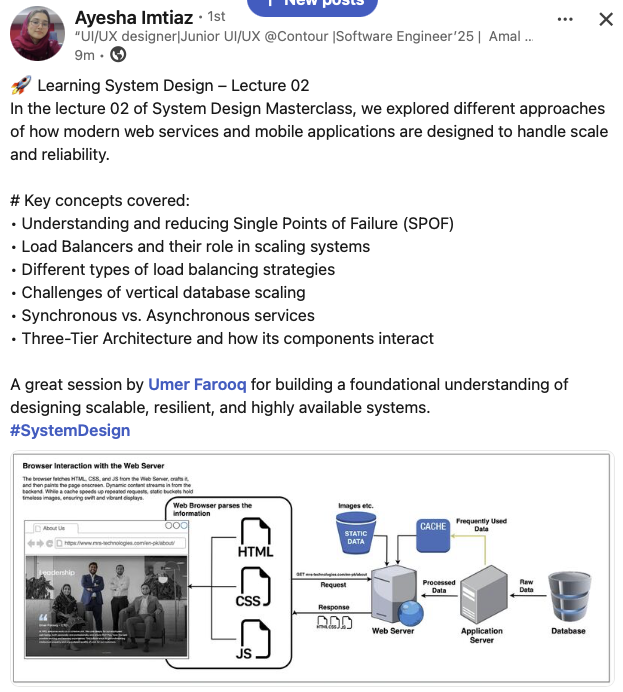
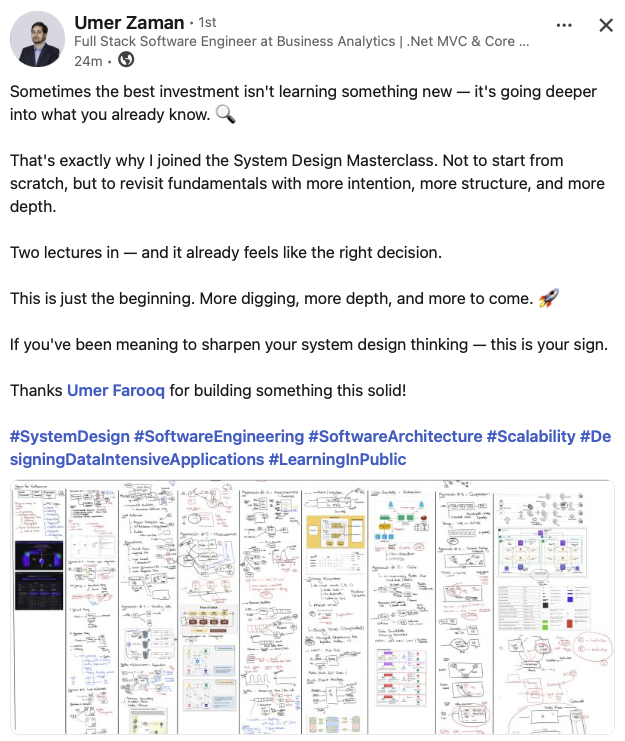
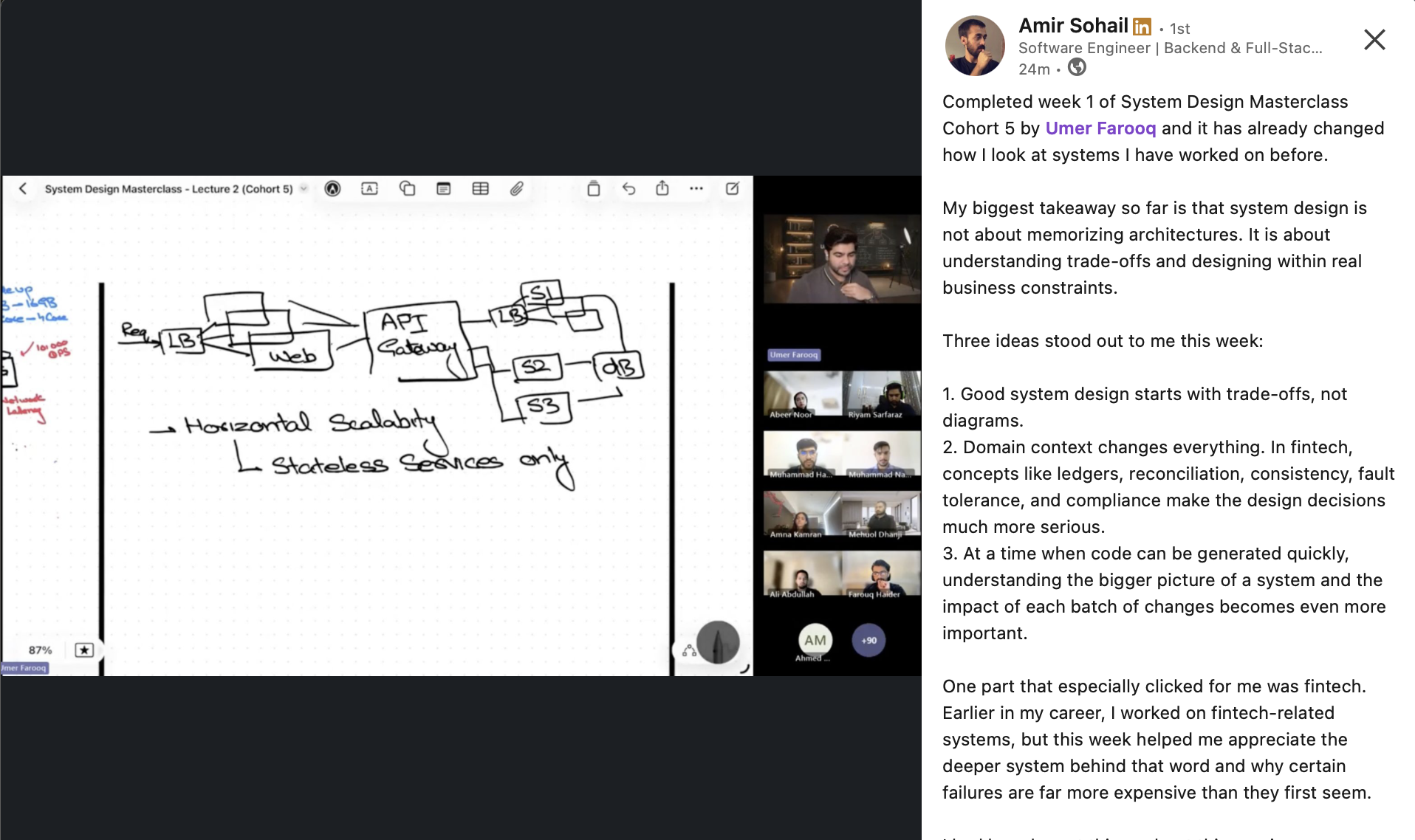
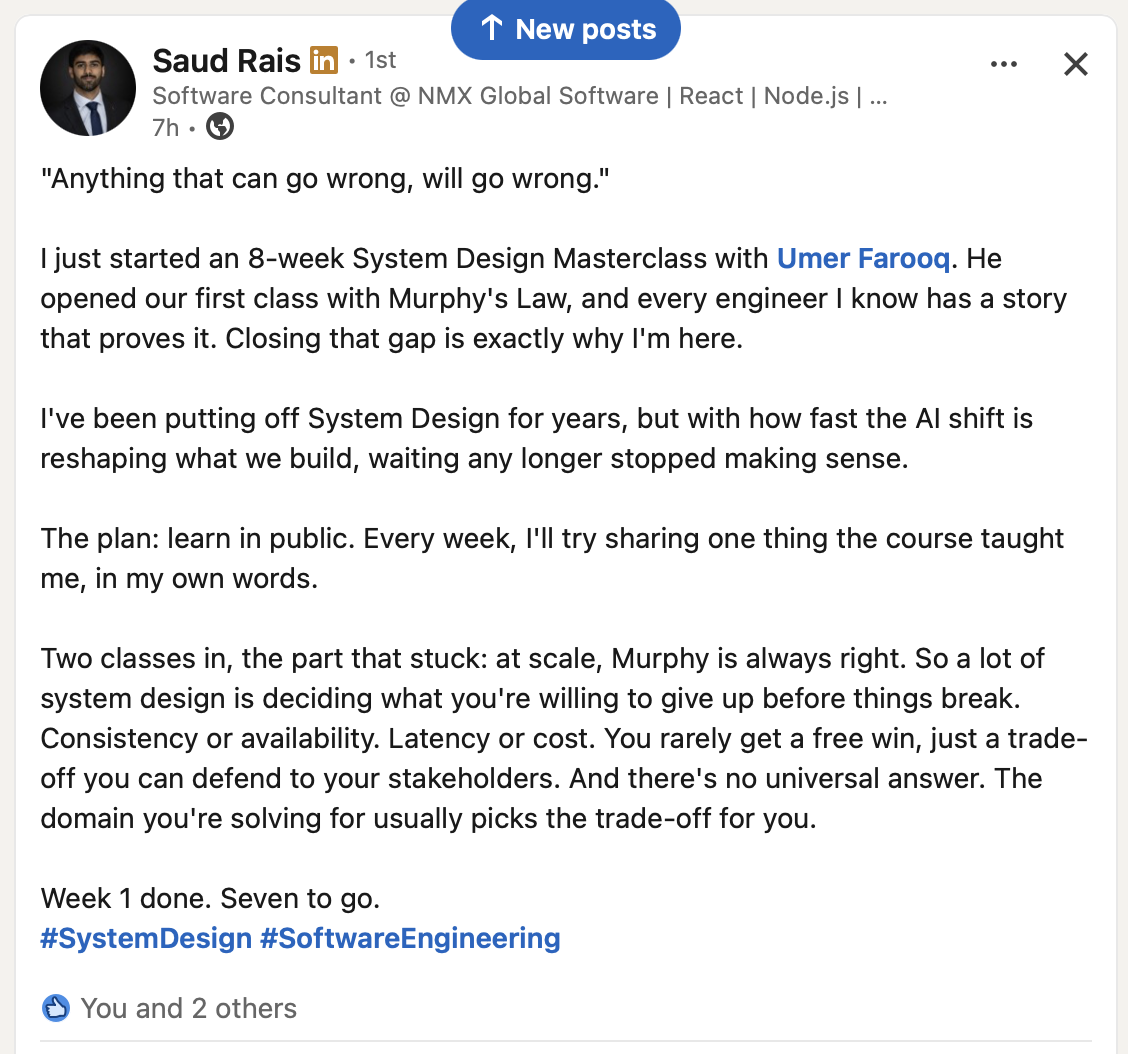
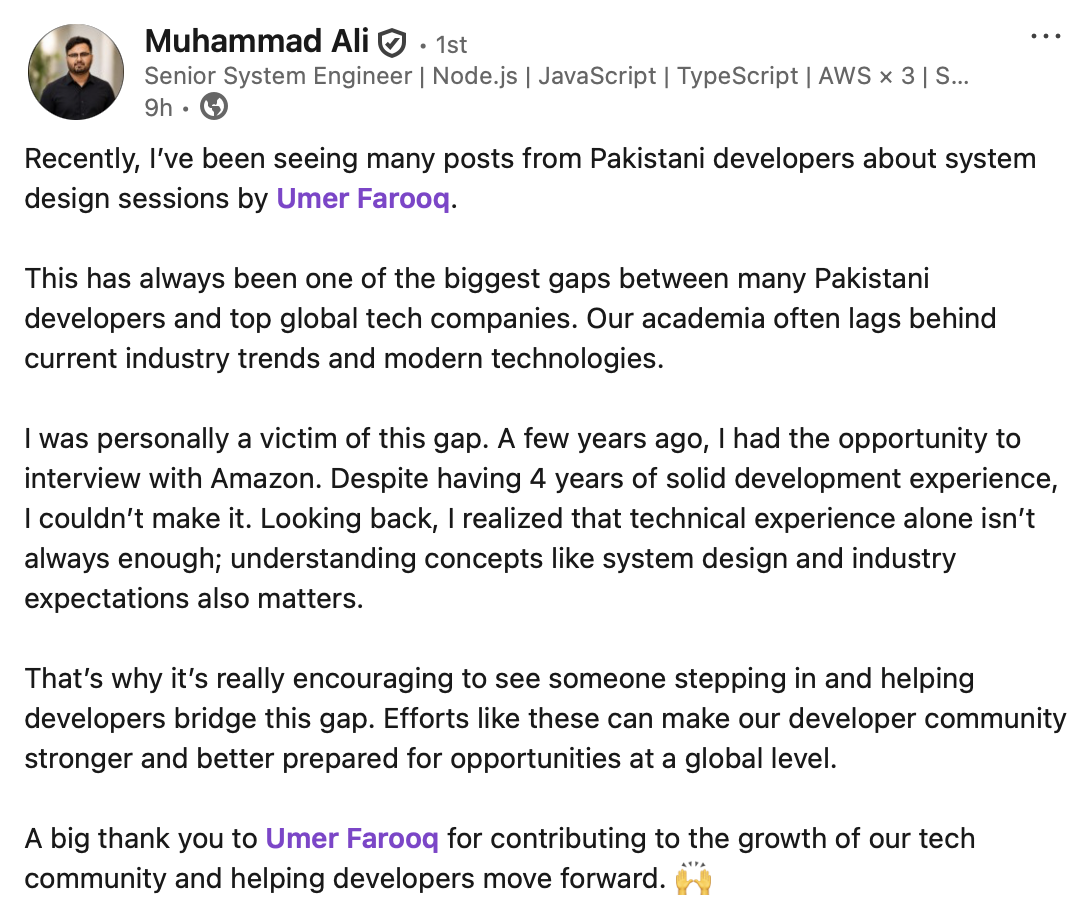
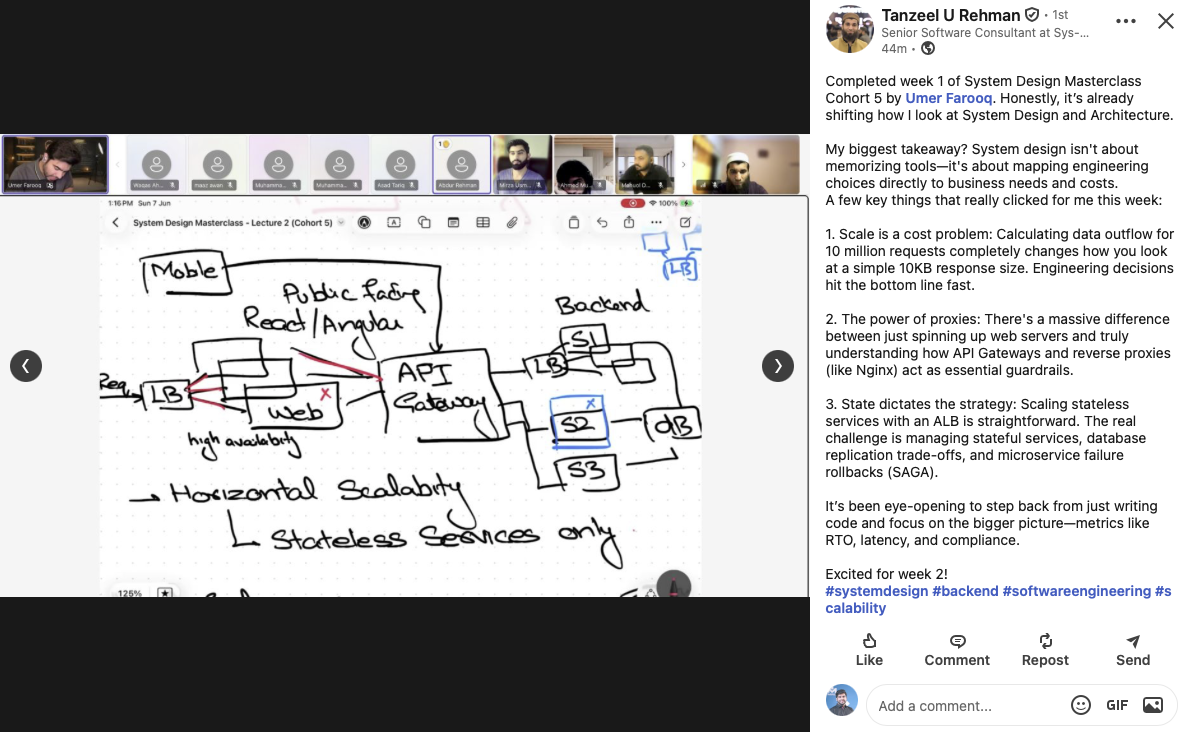
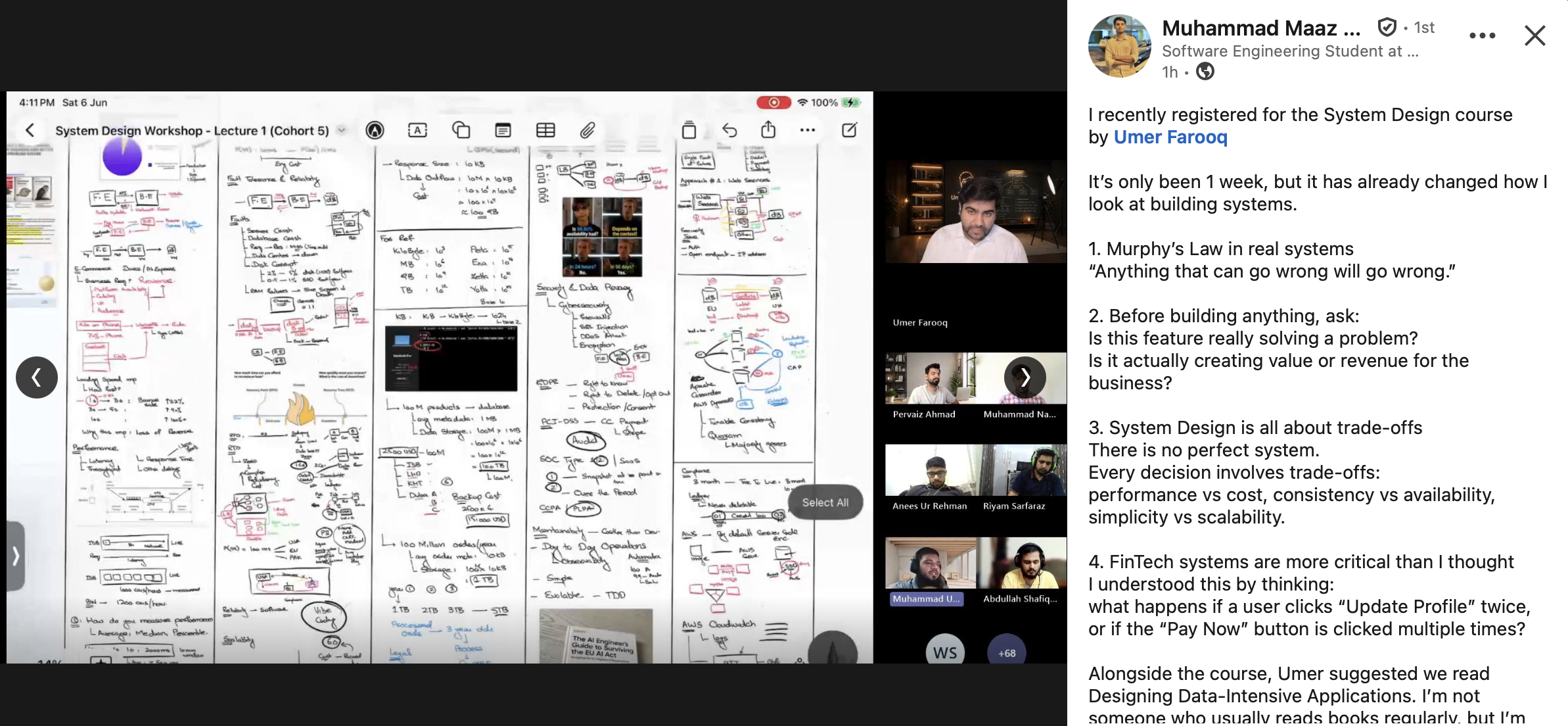
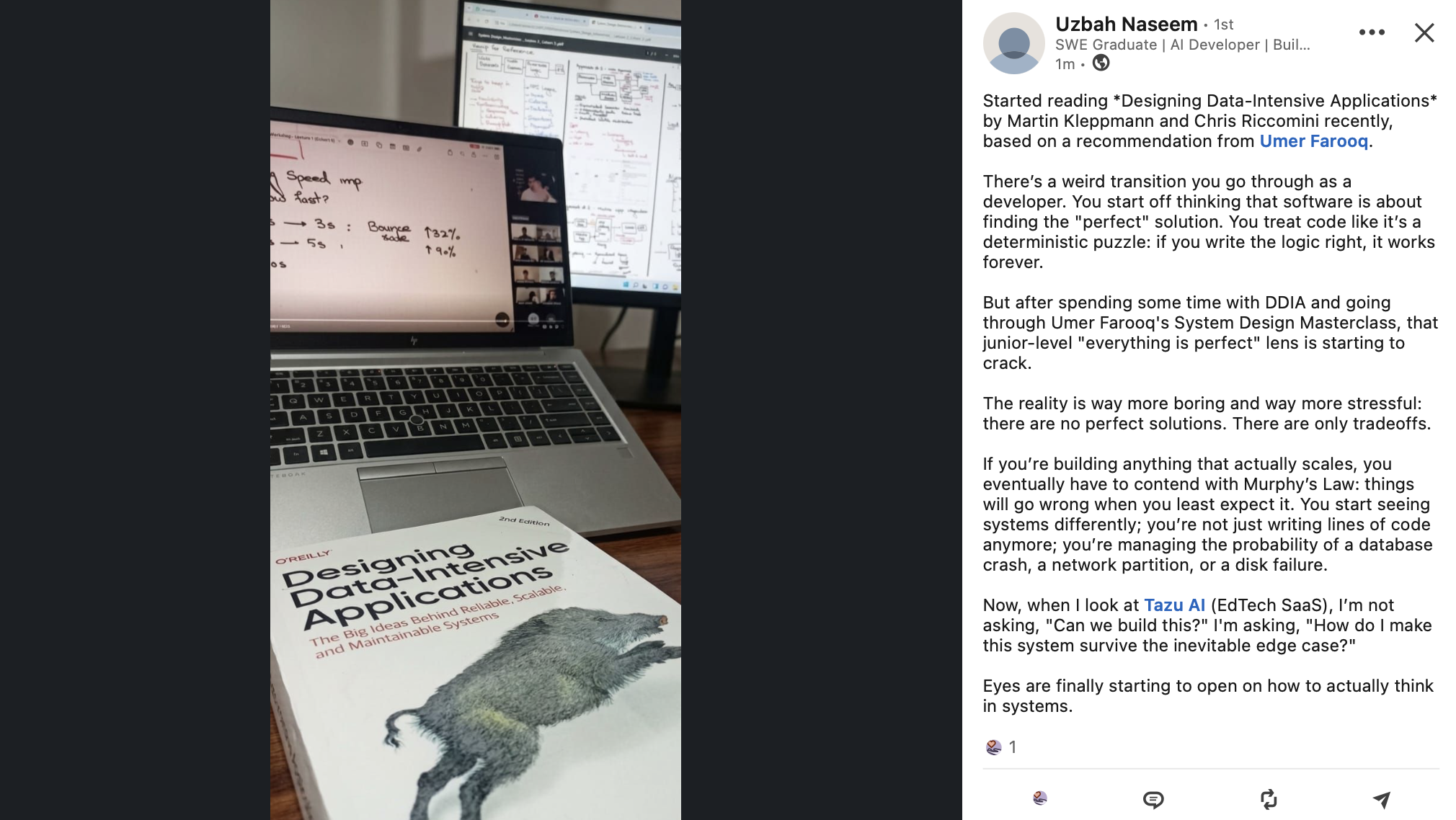
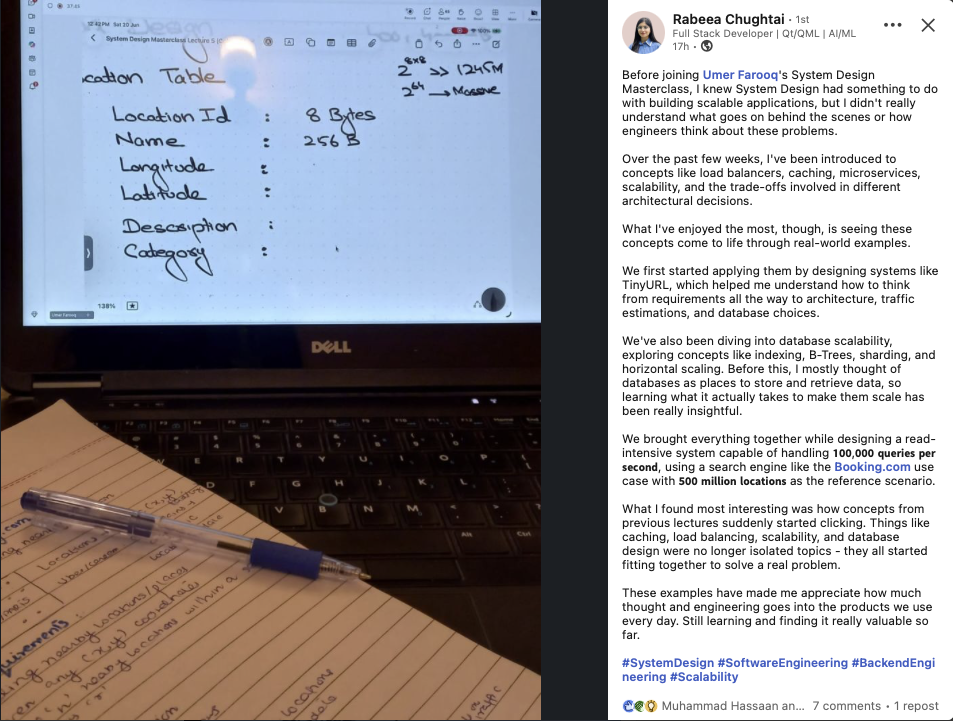
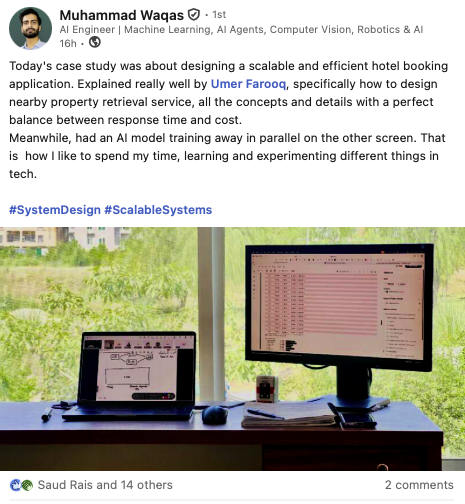
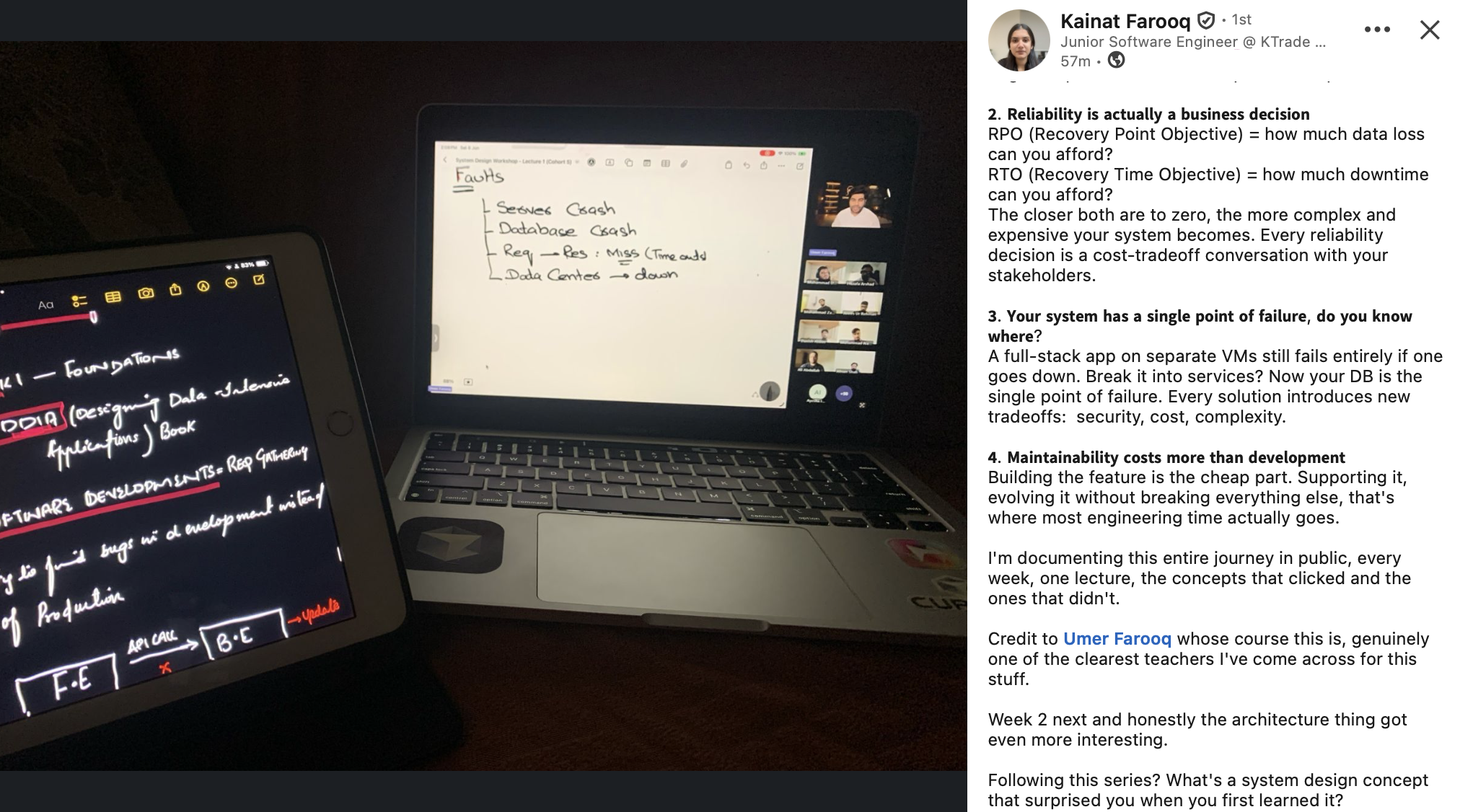
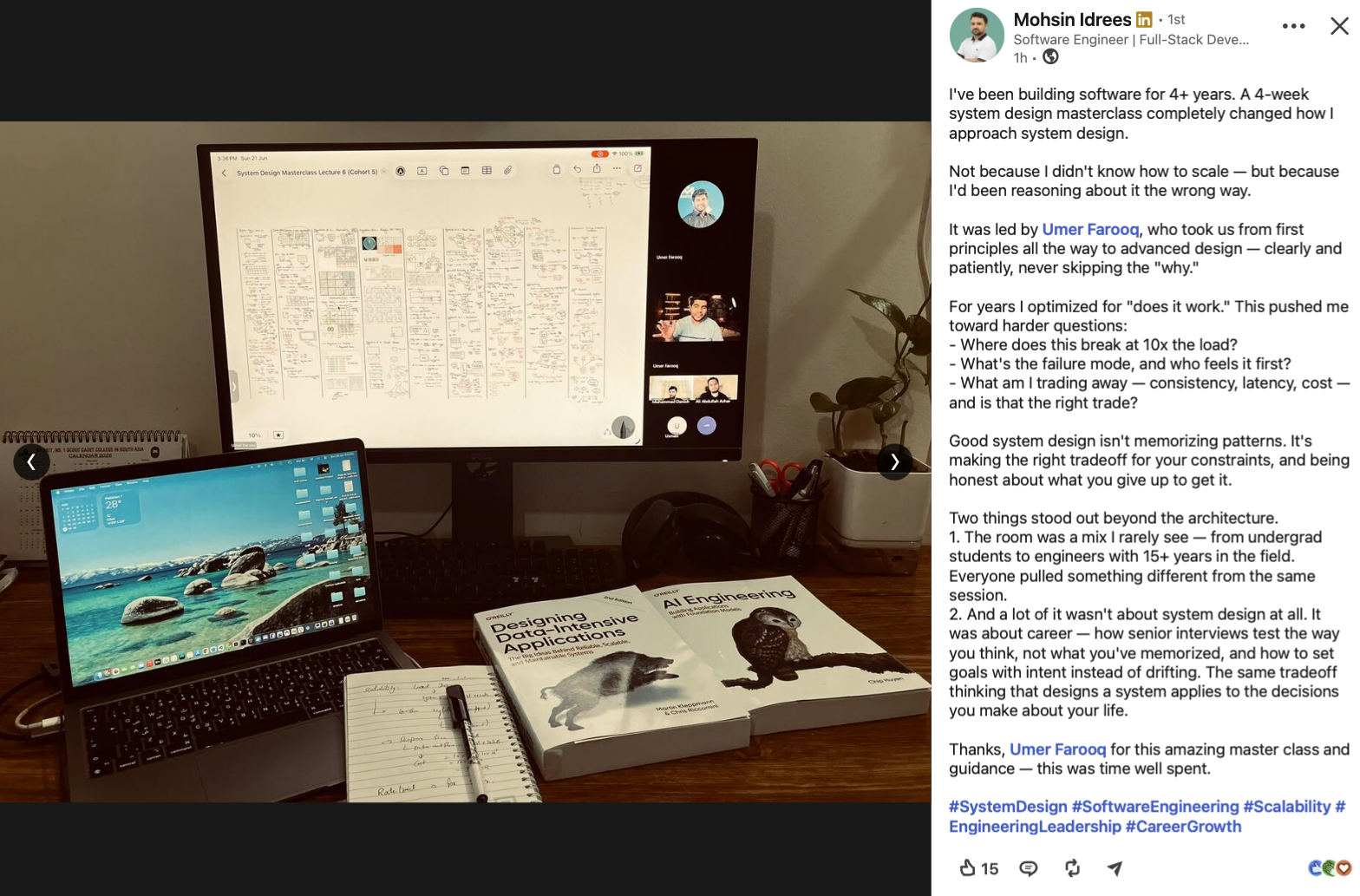
The Network
You're not just buying a course. You're joining a community.
The engineers you learn alongside become your professional network for years. The conversations that happen in the WhatsApp group after a session are often more valuable than the session itself.
If you want to go fast, go alone. If you want to go far, go together.
— African Proverb
The best engineers in Pakistan are learning together in this cohort.
A Community That Grows With You
Your batchmates become your network for life. Engineers who think at the same level as you — at companies across Pakistan and abroad. When you need a referral, a second opinion on a design, or someone who gets it — they're one message away.
Private Cohort WhatsApp Group
Every cohort gets a private group that stays active well after the course ends. Share job opportunities, design problems, interview tips, and industry insights with engineers who've been through the same rigorous training.
Live Q&A — Real Answers, Not Scripted Ones
Every session is driven by your questions. Stuck on a CAP theorem edge case at 9 PM? Ask. Every question makes the entire cohort smarter. This is the kind of learning that no recorded course can replicate.
Mentored Before, During & After
Umer's investment in you goes well beyond the 8 sessions. Before the cohort starts, during weekend breaks, and long after it ends — expect study groups, TA sessions, LinkedIn profile reviews, and bonus workshops on AWS and other tools, driven entirely by what the cohort needs.
Peer Presentations & Feedback
The Capstone project is presented to the entire cohort. You learn as much from defending your design as you do from hearing how others approached the same problem differently. Real engineering culture, built in a classroom.
Instructor Accessibility
Umer is reachable on WhatsApp throughout the cohort. Not just during sessions — but when you're preparing your assignment at midnight, or when a real-world problem at work suddenly connects to something from class.
The Hard Truth
Why free courses won't get you there
There is unlimited free system design content online. So why are most engineers still failing system design interviews? Because exposure is not the same as understanding.
Random videos. No sequence. No clear path.
A deliberate 4-week curriculum. Every week builds on the last.
Surface-level. The hard parts are skipped or badly explained.
We go exactly where it gets uncomfortable — that's where the value is.
You watch 3 videos and stop. No deadlines, no pressure.
Weekly assignments, live cohort, peer pressure, and a capstone you present.
Zero. You can't ask a YouTube video why your design is wrong.
Every session is live, adaptive, and driven by your questions.
A comment section. That's it.
A private cohort, a WhatsApp group active for years, and 490+ alumni.
You feel like you learned something. But freeze in the interview.
You can whiteboard any system, explain trade-offs, and own the room.
Random videos. You don't know what you don't know. You watch a video on sharding and think you're done — but you have no idea about the 10 edge cases that break everything.
A deliberate, sequenced curriculum built over years of teaching. Every week builds on the last. By Week 4, you can reason about any system from first principles.
Surface-level. Free content optimises for views, not understanding. The hard parts — Write Skews, Phantom reads, Consensus algorithms — are either skipped or badly explained.
We go where it gets uncomfortable. The messy, counterintuitive parts of distributed systems are exactly where the value is — and exactly what we spend the most time on.
None. You'll watch 3 videos and stop. Studies show 97% of people who start a free course never finish it.
Weekly assignments. A live cohort. Peer pressure (the good kind). A capstone you have to present. Accountability is the secret ingredient that turns exposure into skill.
Zero. You can't ask a YouTube video why your design is wrong. You get the answer but not the reasoning.
Every session is live, adaptive, and driven by your questions. Real-time discussion with an instructor who has built and designed systems at scale.
A comment section. That's it.
A private cohort of serious engineers, a WhatsApp group that stays active for years, and an alumni network of 490+ engineers across 6 cohorts.
You feel like you learned something. But when you sit in a system design interview, you freeze. The knowledge is there but it doesn't connect.
You can whiteboard any system. You can explain your trade-offs. You can answer 'why' — not just 'what'. That's the difference between passing the interview and owning the room.
PKR 20,000is not a cost. It's an investment.
One senior engineering role pays back this investment in the first week. The question is not whether you can afford this course. The question is whether you can afford to keep guessing.
Invest in Your Career →Secure Your Seat
Join Cohort 7 — 2026
One cohort. One price. Everything included. Fill in your details and we'll send payment instructions.
Early Bird Price
Save PKR 5,000· Limited Time Only
Goes up to PKR 25,000 after 30 September
- 8 live, interactive sessions on Microsoft Teams
- 4 weekly design assignments with feedback
- Capstone project presentation
- Course Completion Certificate
- Access to session recordings
- Private cohort WhatsApp group
- Q&A, TA sessions & office hours support
- Start: October 17, 2026
- Schedule: Every Saturday & Sunday, 12:00 PM – 3:30 PM PKT
- Format: Live Online (Microsoft Teams)
Group Discounts
Registering with colleagues? Save more together.
2 Participants
PKR 18,250 / person · Save 1,750 each
3 Participants
PKR 16,667 / person · Save 3,333 each
Have questions?
WhatsApp Umer directly on 0335-5234560
Beyond Software
Umer's love for robotics.
Long before system design interviews existed, Umer was building machines that moved. Robotics gave him a first-principles relationship with hardware, embedded systems, real-time constraints, and the kind of problem-solving that no whiteboard exercise can teach. That same instinct — design it, build it, break it, improve it — is what he brings to every session.
2011–2012
ABU Robocon
Designed and built Pakistan's competition robots for ABU Robocon — one of the world's most prestigious student robotics championships — competing in Thailand (2011) and Hong Kong (2012).
2012
Gold Medal — Final Year Project
His robot was his final year engineering project at CASE. He graduated with the Gold Medal in Electrical Engineering — the capstone of a programme he dominated from the start.
2016
Robominors & First Global
Co-founded Robominors to teach children robotics, programming, and electronics. Went on to mentor Pakistan's national team at the First Global League robotics competition in Washington D.C.
2019
MS Robotics — NUST
Earned a Master of Science in Robotics and Intelligent Machine Engineering from NUST with a perfect 4.00 CGPA and the President's Gold Medal — Pakistan's highest academic honour.
See the Work in Action
Representing Pakistan on the International Stage
ABU Robocon 2011 — Thailand
Pakistan's national robot demonstration at the international ABU Robocon competition held in Thailand.
ABU Robocon 2012 — Hong Kong
Live demonstration in front of PTV — Umer's final year engineering project, representing Pakistan at the international stage in Hong Kong.
The best engineers do not just build systems — they understand why every decision was made. These articles are where that understanding begins.
From the Blog
Start reading. Start thinking differently.
View all articles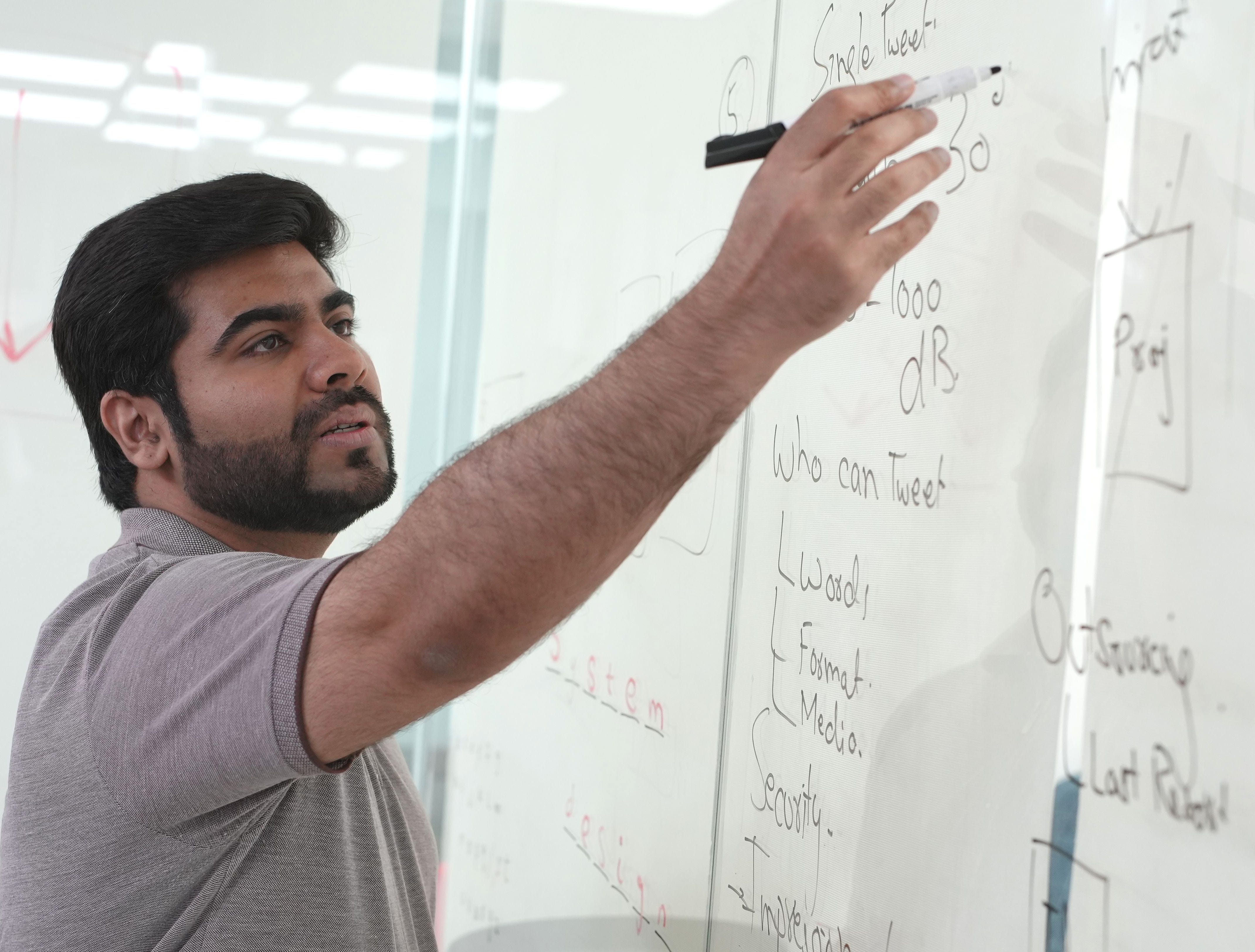
System Design For Beginners: Part I — Getting Started
Every time you open a taxi app, book a ride, and chat with friends while the car moves — you are touching a system that serves millions of simultaneous users. This article breaks down exactly how those systems are built from first principles.
Umer Farooq·12 min read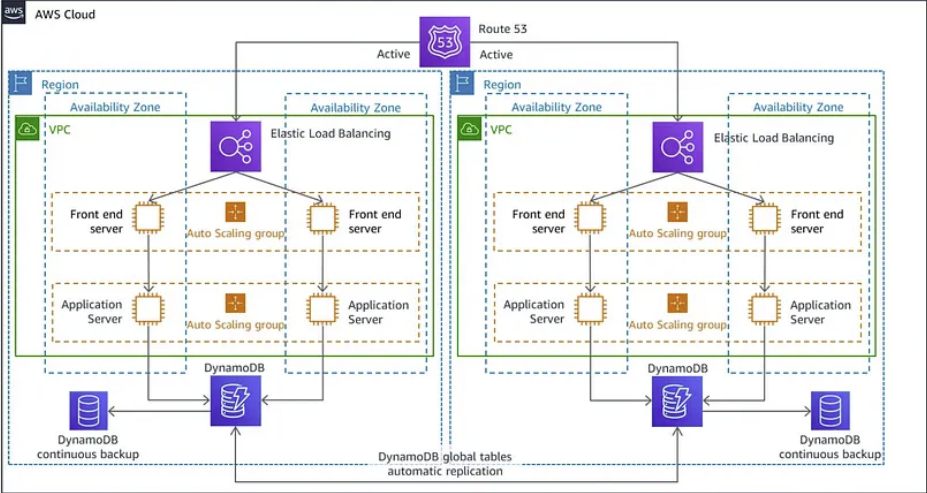
System Design For Beginners — Part II: Understanding the 3-Tier Architecture using Everyday Analogies
The 3-Tier Architecture is the backbone of virtually every web application you have ever used. Using everyday analogies, this article makes the pattern intuitive — so you can apply it rather than just recognise it.
Umer Farooq·13 min read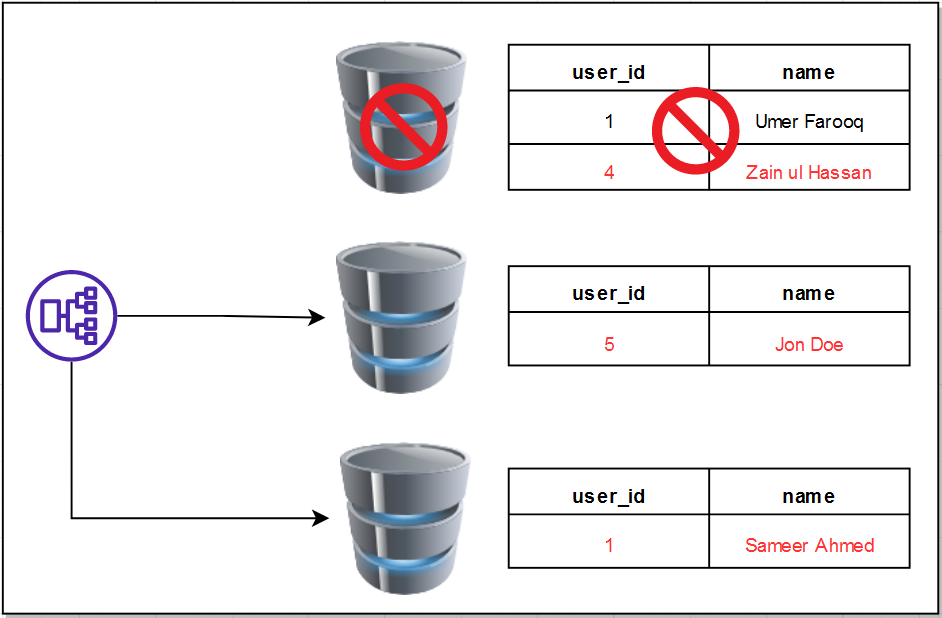
System Design For Beginners — Part III: Database Scalability with Use Cases
When a candidate is asked how they would scale a database, most engineers freeze. This article walks through real use cases and the exact decision-making framework that separates senior engineers from everyone else.
Umer Farooq·12 min readRead the full series on Medium
Over 1,100 readers and growing. Free to read. No sign-up required.